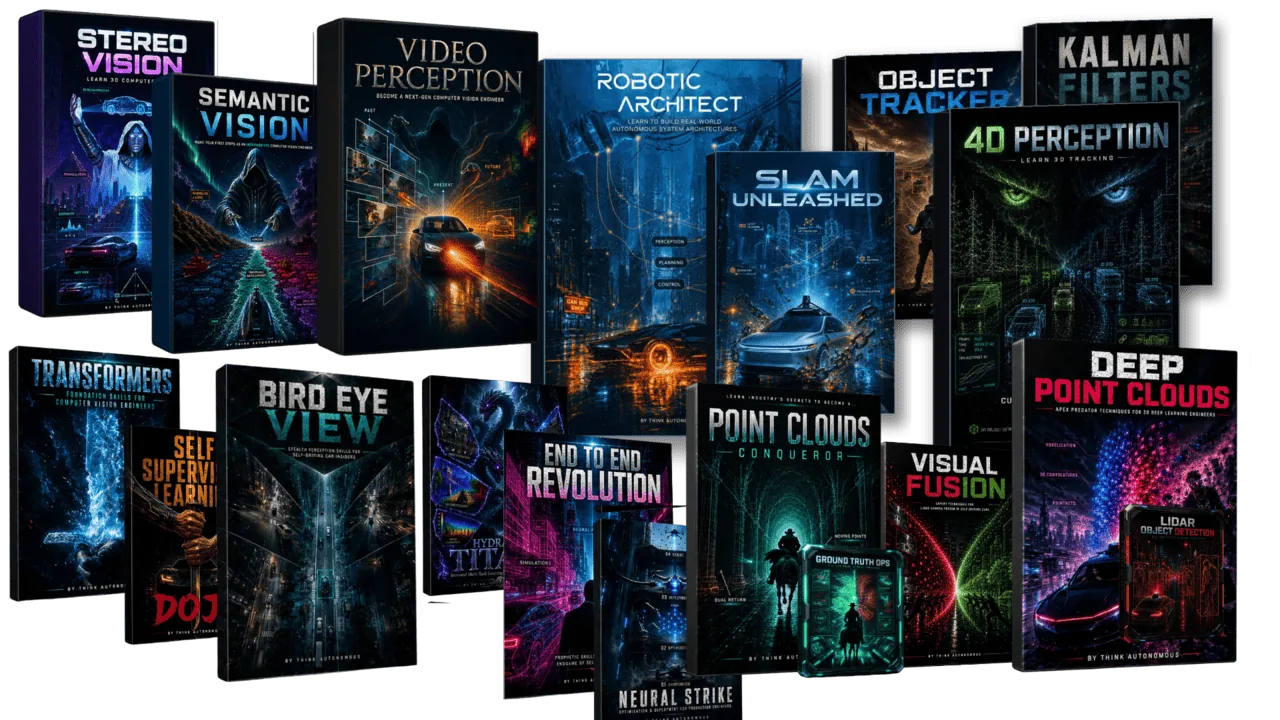
The Deep Learning Pack will show you ...

Get AV 2.0 Certified by learning Advanced DL Skills

Build skills on the entire AV 2.0 stack

Get the Deep Learning PackTotal Value: 1,820€
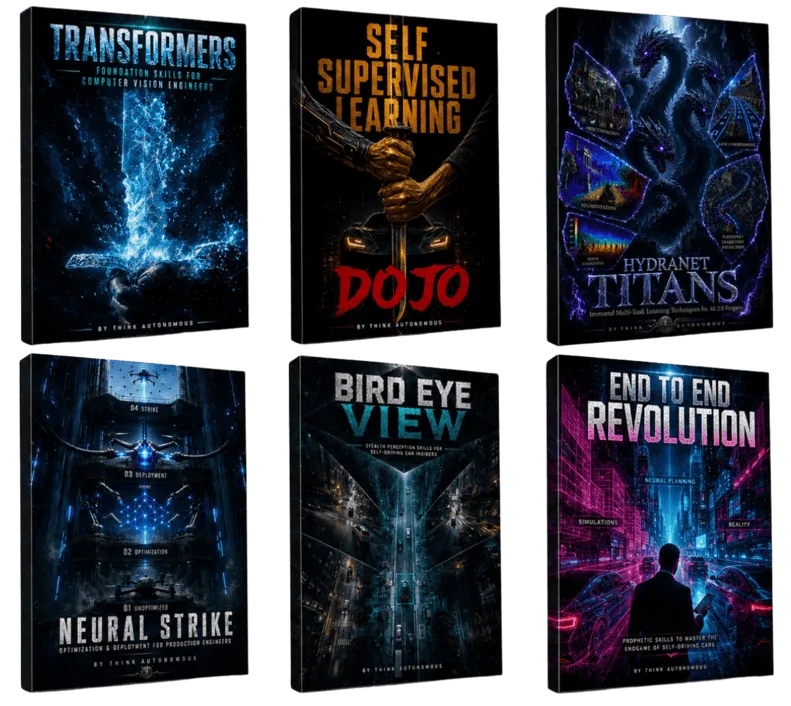
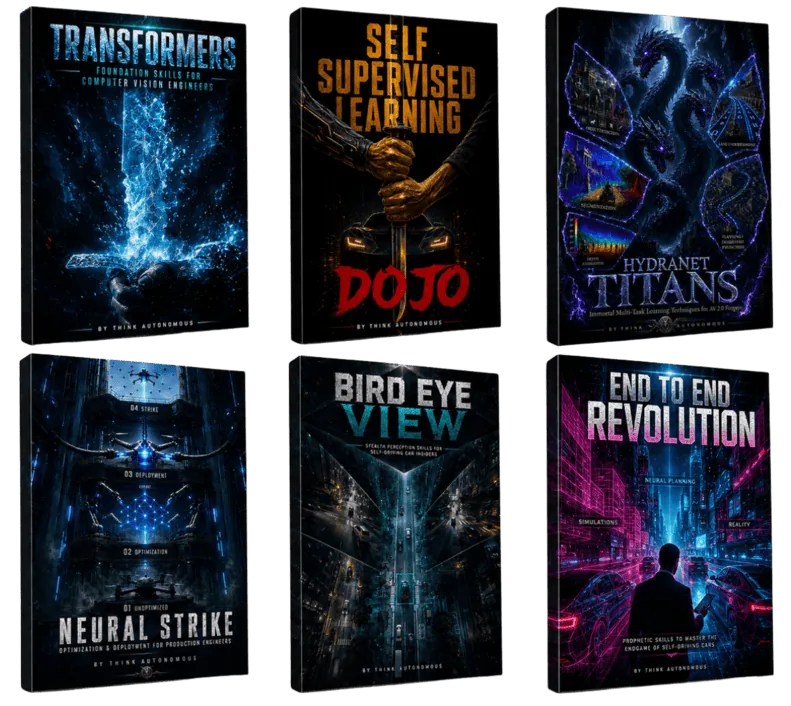
The Advanced Deep Learning Pack: Transformers, Self-Supervised Learning Dojo, HydraNet Titans, Neural Strike, Bird Eye View, End-To-End Revolution

In the next few minutes, I want to show you how you can...

Evolve from AV 1.0 to AV 2.0 and to even... AV 3.0 Engineer!

I want you to be part of it. This is why I made this bundle.

If you are an Engineer who wants to work on Autonomous Robotics, then let me show you what your job might possibly be...

Dear Engineer, there are good chances that if you're hearing about AV 2.0 for the first time, you are getting left behind.

And this without even realizing it.

Let me tell you a story...

A few years ago, there was a heavy debate in the self-driving car industry between traditional approaches (made of algorithms and manual processing) versus Deep Learning.

2 Deep Learning algorithms I put inside an autonomous shuttle. Today? These are starting to be slightly outdated... The Physical AI Revolution is taking place!

When I became a self-driving car engineer, the autonomous shuttle startup I worked for hired me for Deep Learning. Problem? My CTO was a big DISBELIEVER of Deep Learning.

He considered that we needed to have "deterministic" outputs. To him, Deep Learning was a joke. One day, as I was barely 1 month old in the company, we went into an argument, where he asked me to stop working on Deep Learning algorithms, and work with the rest of the team on traditional.

I refused. We had a 2h argument, and here is where it got spicy:

The CEO who was next door overheard the entire phone conversation.

The next day, I was ready to pack my things, when they gathered us to announce that...

Our CTO had been fired!

I wasn't happy about that decision, but I was happy to keep my job. However, something became very clear that day; the future would be built WITH Deep Learning.

The conservatives, who claim they want to see "deterministic" outputs are right in a way, but they're also wrong in every way.

Yes, they did build some robots, but they didn't make the Physical AI revolution happen...

Deep Learning folks did.

Today, we're seeing the exact same debate happen within End-To-End Learning: Should we go Modular so we have some granularity and explainability, or should we go End-To-End? We call that debate AV 1.0 (Traditional & Modular) versus AV 2.0 (DL based and End-To-End).

Traditional & Modular

PerceptionLocalizationPredictionPlanningControl

DL based and End-To-End

CamerasLiDARs
End-To-End NetworkWaypoints

Reasoning / Reinforcement

CamerasLiDARsLanguage
VLA / World ModelActions

Once again, the End-To-End folks like Tesla, Nvidia, Wayve, Waymo, and others will be right.

Are you going to be part of the AV 2.0 group? Or part of the "expert conservatives", frustrated when they see new tech arrive?

A look inside

A LOOK INSIDE THE DEEP LEARNING PACK

The Advanced Deep Learning Pack

The Deep Learning Pack isn't teaching you the basics. Neural Networks? CNNs? Forget about it. This is our first criteria; you're supposed to already know that stuff and be looking for advanced. If this isn't your case, then this pack isn't for you.

But if it is, then let's see what I got in store for you...

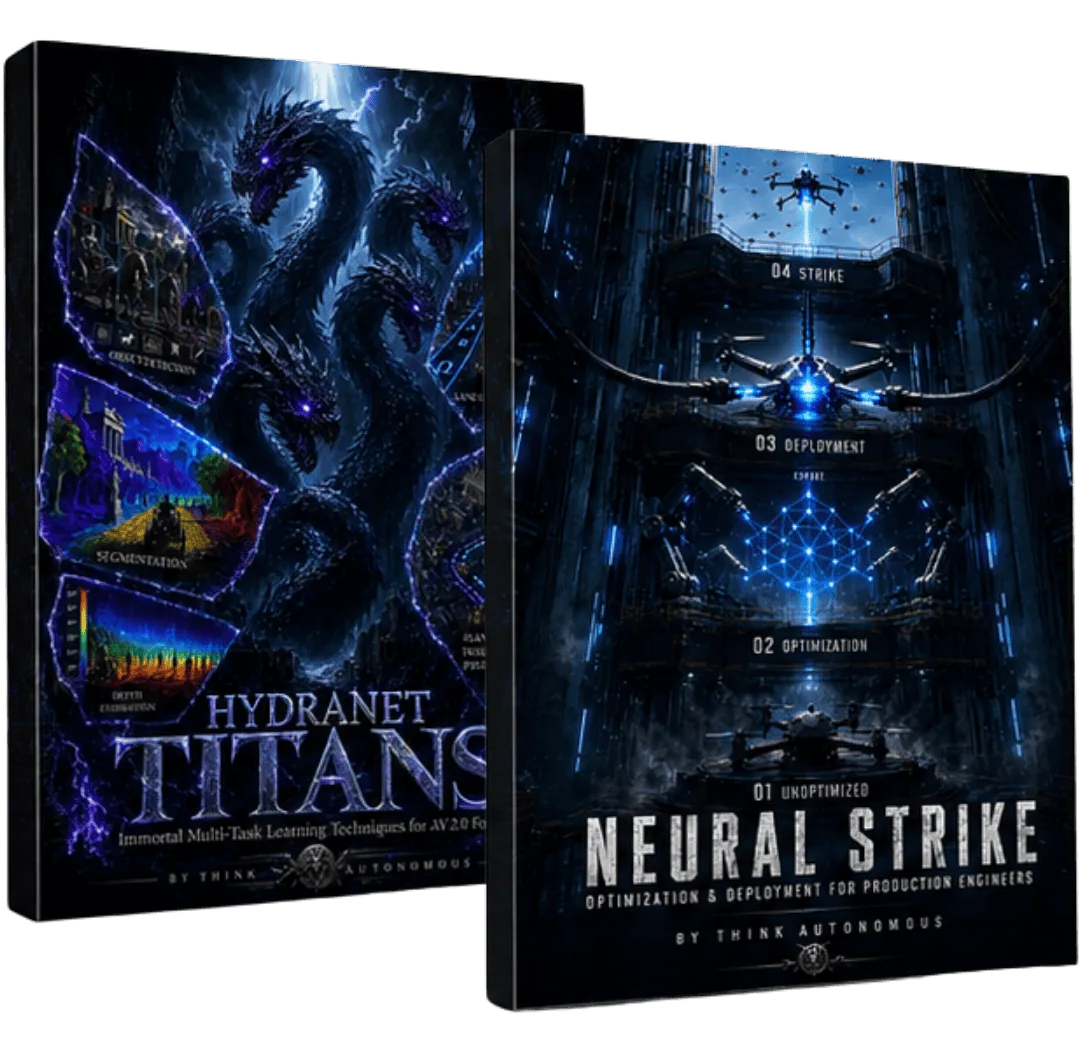
01HYDRANET TITANS & NEURAL STRIKE course cover

MASTER MODERN NETWORKS

HYDRANET TITANS & NEURAL STRIKE

First, you're learning how to build architectures designed for Multi-Task Learning in Production environments.

This is the shift from "I can build one CNN on a notebook" to "I can ship End-To-End networks in embedded environments, running at 50 FPS on tiny GPUs".

These 2 courses are from May and June 2026, extremely new and modern.

For example, in HydraNets, you will learn:

  • Why nearly all End-To-End architectures are HydraNets, and how to add near unlimited heads to a network
  • Why naively adding task losses destroys your network, and how to balance them so every task actually learns
  • Why a model with 95% accuracy can still be completely wrong, and the visualization technique that exposes it (many models overfit or simply associate patterns to outputs, like grass with cows; we'll see how to REALLY learn)
  • HydraNets 2.0: The 4 components (Backbone, Head, Context, Neck) to master to be at the level of E2E DL Research Labs (and how to build one from scratch)
  • How to build temporal lane detection heads (when you think about it, some tasks like lane detection should NOT be frame-per-frame, we'll see how to engineer a professional pipeline solving it)
  • How to build Foundation Segmentation Model that detects objects it was never trained on using pure CNNs (and how to stop doing 2017 deep learning)
  • The #1 skill that separates engineers who can modify a production architecture from those who can only run one (this is a collective project where you will not only modify your architecture, but also report it to a "hub" and benefit from everybody else's own experimentations)
  • The "dead HydraNet" technique companies like Autoware use (and you will do it from scratch) to assemble E2E models quickly
  • 3 Ways to Build Object Detection Heads
  • And many more...
You'll build your own HydraNet
You'll learn to adjust its internal learning

And in Neural Optimization, you will learn:

  • Why asking for the biggest, most expensive GPU is a rookie move, and how the pros get models running on the hardware they're actually given
  • How a minor change to your convolutions can make a network up to 96% faster, with barely any accuracy lost (it's the same trick that makes MobileNets so fast, and almost nobody outside research uses it on purpose)
  • How to execute CUDA streams, context operations, and build your own inference engines in production, using C++ (you'll then code your own Python version, approved for production)
  • Neural Calibration: How to leverage weight "calibrators" to ensure optimized models work in production (goes without saying that every time you 2x your model, you slightly decrease its accuracy, pros use calibrators to reduce the error)
  • How to ‘export’ PyTorch models to portable graphs so they can run anywhere (most engineers save .pth files after training, this is the WRONG way to do. We'll see how self-driving car companies actually do, and the 3-step flow companies like Neolix implement in production.)
  • Advanced Case Study: How Autoware uses ONNX and TensorRT to DEPLOY Neural Networks in production using C++ (we'll do a complete deep dive on the code they use, and how they deploy models on Nvidia GPUs)
  • Neolix's AI Deployment HEAD teaches the 3-step framework he used to DEPLOY AI Models in Production on tiny Nvidia chips (most AI engineers are clueless about this)
  • And many more...

So this is JUST the first two courses... Then we got MORE!
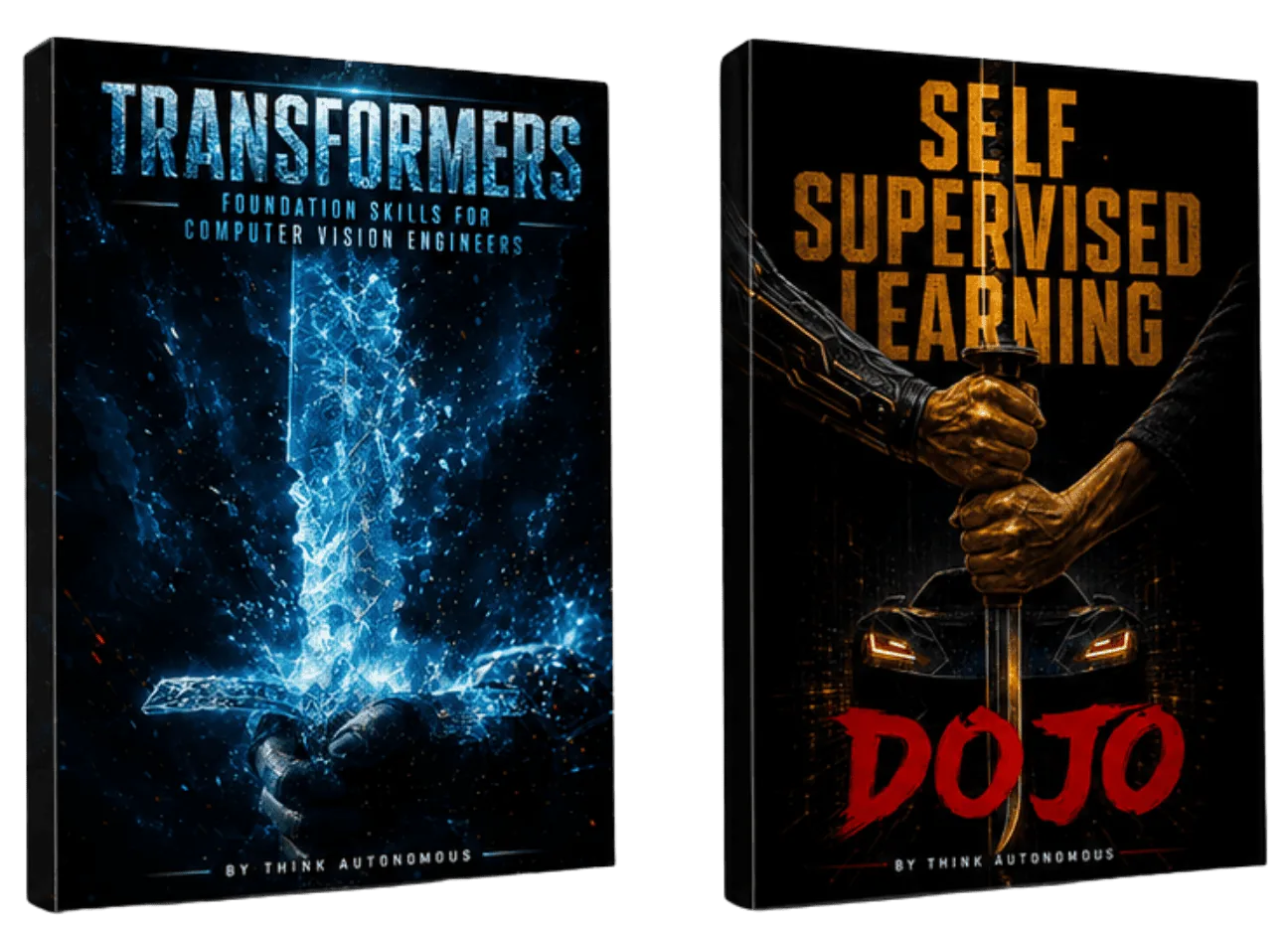
02TRANSFORMERS & SELF-SUPERVISED LEARNING DOJO course cover

BUILD FOUNDATION KNOWLEDGE

TRANSFORMERS & SELF-SUPERVISED LEARNING DOJO

Next, we'll work on the engine. If you want to build AV 2.0 (End-To-End/Imitation) or even AV 3.0 (Reasoning/Reinforcement), you're going to need the basics: Transformers & Self-Supervised Learning.

You will learn Transformers, and in particular Vision Transformers.

If you've never been through a Vision Transformer course, you probably noticed how they get shallow when it comes to understand certain concepts, like Query/Key/Value. In this course, we do it differently; rather than showing you text and chatbot examples, we show you only visual examples. So you understand how a model turns its attention to specific parts of the scene when being used.

Put differently, it's a course designed for Computer Vision Engineers, not just anybody interested in AI.

Build a complete understanding of Attention, Query/Key/Value, Transformer Networks via interactive and visual examples
Master Advanced and Efficient Transformer architectures (even build your own and learn to visualize its internal components)
Learn Self-Supervised Learning, both in theory and practice (in fact, you'll build your own SSL architecture for 3D Reconstruction & Depth Estimation, 0 labels used, 0 supervision)
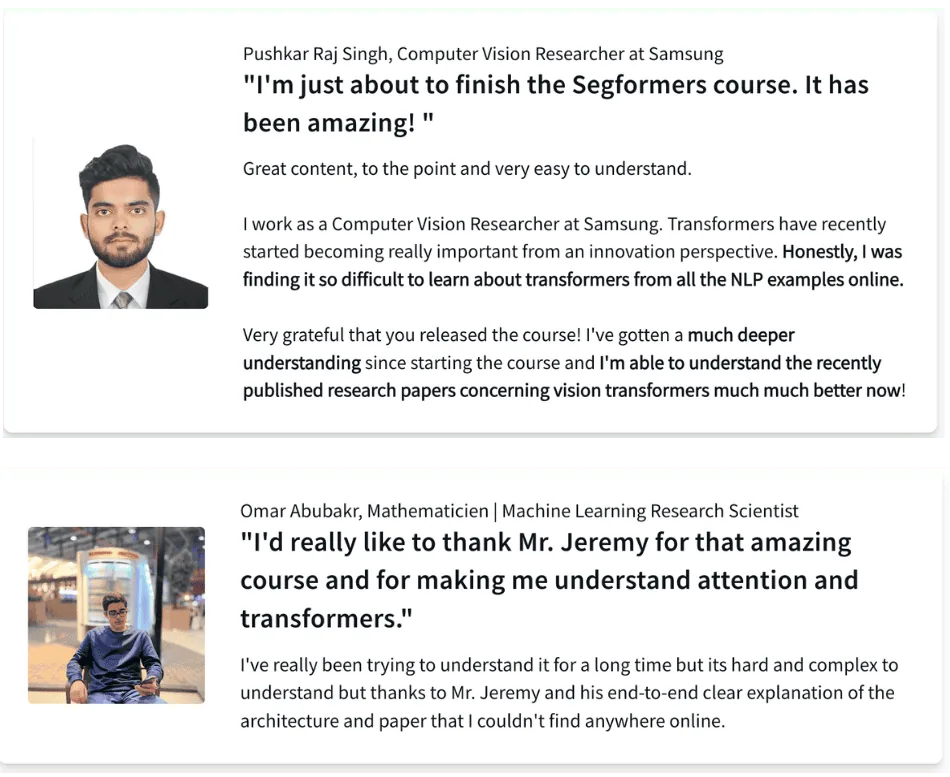
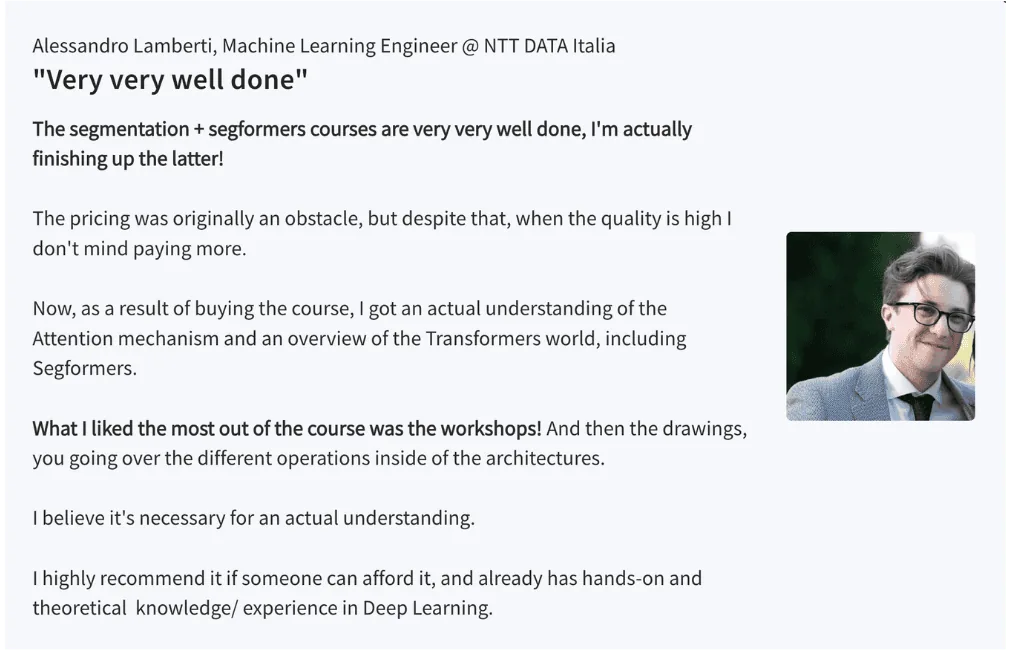
What students say about TransformersWhat students say about Transformers
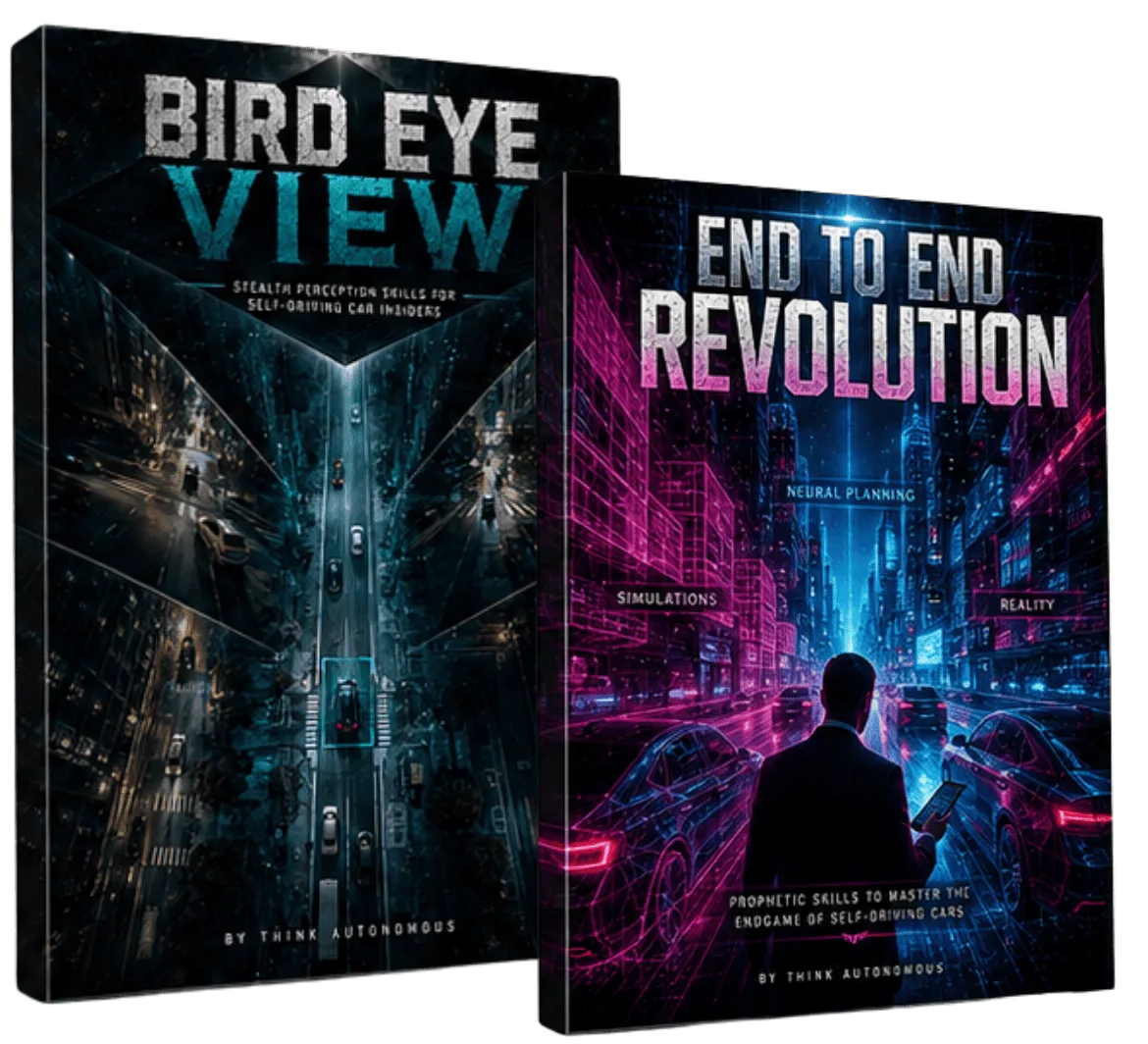
03BIRD EYE VIEW & END-TO-END REVOLUTION course cover

MASTER AV 2.0

BIRD EYE VIEW & END-TO-END REVOLUTION

Finally, you'll dive into the core of AV 2.0 by learning Bird Eye View Networks and End-To-End architectures. You'll design and ship your own E2E architecture trained on human data.

Cherry on the cake? I don't know, but here is where everything compounds. Once you know about HydraNets, about Transformers, about Self-Supervised Learning, and about Neural Deployment... you're ready to master the cutting-edge architectures used inside companies.

Here is what you'll learn in the final 2 courses:

What you'll learn inside the Bird Eye View course:

  • Become a "Stealth" Deep Learning Engineer (Stealth is a concept I explained as the skills engineers all master internally but don't necessarily share publicly, Bird Eye View is one of them)
  • BEVFormer: An In-Depth look at the most powerful 3D Object Detector, and how it uses Bird Eye View Grids to map objects into a common representation.
  • How to combine Geometry and Deep Learning in algorithms like Spatial Transformers to make algorithms converge 100x faster (hint: using geometry will act like using a pre-trained model: traditional geometry techniques are okay, but Deep Learning acts as a "refiner" in our case)
  • The 3 Core Blocks of a Spatial Transformer Network, and a step-by-step guide on how to turn Features into Bird Eye View features (in this part, we'll actually visualize all the features ourselves, at each step of the network, to understand when the features are fused, and how much they're transformed)
  • A look at some Pure Neural Net approaches to estimate Bird Eye View without depth maps or geometric parameters (yes, this is possible, but has one major drawback, more detail on the summary of this module)
  • Practical Secrets to compress datasets from hundreds of Gb to a few Mb (it works for almost all image based datasets, and we'll use one-hot encoding and decoding for segmentation tasks).
  • How to train a Bird Eye View Network, including the loss function you should use, and the hyperparameters suitable for this kind of transformation.
  • 🚀 DEEP BIRD EYE VIEW PROJECT: Build and Train the Multicam Fusion Network that does Bird Eye View Visualization & Semantic Segmentation.

What you'll learn inside the End-To-End Revolution course:

  • Become an AV 2.0 Engineer with visual proof of your skills (you'll build your own multi-modal, multi-task Transformer trained End-To-End)
  • The secrets of Deep Motion Planning, and examples of x4 algorithms that use Deep Learning to generate waypoints (although there isn't yet a complete 'classification' of Deep Planning algorithms, we'll use our intuition to build our own)
  • A Deep Dive into the thrilling TransFuser Architecture, and how it's used for End-To-End Autonomous Driving using LiDARs and Cameras (the magic part of it is that it's not just a camera based E2E algorithm, but also takes LiDARs, which will have us look into Deep Fusion)
  • Why the best end-to-end algorithms are "modular end-to-end", and 2 simple techniques to enable "Gradient Flowing" in self-driving cars
  • The number 1 rule to follow when plugging the output of Perception to the input of Planning (and some advanced variations of the simple sequential flowing)
  • What Andrej Karpathy meant when he said Tesla is using "Fixed Queries" in Occupancy Networks, and an eye popping demonstration of how to train queries for specific tasks like tracking or segmentation
  • A detailed overview of modular motion planning, both high and low level (if you are going to be the "Deep Planning guy" of your company, it'll make some sense to study Deep Planning right after studying traditional Planning, which is what we'll do here)
  • Deep Planning: How to use LSTMs/GRUs to predict a waypoint sequence that makes sense and follows a realistic trajectory (in fact, it's not just "how to use", but we'll see a concrete end-to-end example of Gated Recurrent Units in action for waypoint prediction)
  • End-To-End Project 🔥: Inside a "from scratch" End-To-End architecture that fuses camera and LiDAR and plugs that to Deep Planning to drive autonomously in simulation data
Lift Splat Shoot Workshop: Build cutting-edge Deep BEV skills (this specific 'LSS' algorithm is used in almost every paper that implements Bird Eye View, including Waymo's 2026 models)
Understand how to visualize what an End-To-End Network is learning (many claim E2E is a black box, we'll prove this argument is wrong and see 5 ways to understand what a network predicts)

HOW MUCH IS THE DEEP LEARNING PACK WORTH?

Think Autonomous · Advanced Deep Learning Pack

LEARN TRANSFORMERS199€
SELF-SUPERVISED DOJO129€
HYDRANET TITANS299€
NEURAL STRIKE399€
BIRD-EYE VIEW299€
END-TO-END REVOLUTION495€
TOTAL VALUE1,820€

This isn't about what it cost to get.

It's about what it costs to NOT get it.

If you stay on AV 1.0, you're going to do fine for a short while, until...

Shall I continue?

This is what it really costs not to get it.

The Advanced Deep Learning Pack is available. The cards are in your hands...

Essential

Advanced Deep Learning Pack

The Advanced Deep Learning Pack
  • LEARN TRANSFORMERS [199€]
  • SELF-SUPERVISED LEARNING DOJO [129€]
  • HYDRANET TITANS [299€]
  • NEURAL STRIKE [399€]
  • BIRD-EYE VIEW [299€]
  • END-TO-END REVOLUTION [495€]

Value: 1,820€

UNLOCK THIS OFFER

* 3-time payment available

All In

The Mega Pack

The Mega Pack: every Think Autonomous course
  • Everything in the Advanced Deep Learning Pack [1,820€ value], PLUS
  • Computer Vision Pack [1,440€ value]
  • The Tracking Pack [923€ value]
  • The LiDAR Pack [1,441€ value]
  • The Robotics Pack [644€ value]
  • Edgeneer Land Membership & All Fragments [1,997€ value]

Value: 8,565€

Today: 3,997€ only

UNLOCK THIS OFFER

* Installments of 3, 6, or 12 payments are available

FAQs

What is the format of the courses?

Each course is a home-study course with immediate access. Each lasts between 5 and 10 hours, depending on if you want to go the quick road and simply understand the skills and build projects, or invest time mastering the craft and building more expertise. Most lessons are text and video based, coming with hands-on projects.

Can I ask you questions if I'm stuck?

Yes, these courses (like all my courses) is hosted on our 2.0 platform, optimized for support, answers, and community learning. You might very well ask questions there and get very quick answers from me or other students.

What are the prerequisites?

This pack is a "Zero-To-Hero" kind, but it still requires abilities with:

  • Coding in Python
  • Linux Systems
  • Deep Learning for Computer Vision up to CNNs
  • Very good understanding of Level 2 Computer Vision (Object Detection, Segmentation, Depth, ...)
  • Strong understanding of self-driving car basics
  • Willingness to see your brain melt due to the awesome concepts you'll learn
The price is too high for me...

Then go with the instalments. I made sure that there is no real obstacle between you and learning. The real question is... are you ready to make a drastic change in your skills and become a different type of engineer than you are today? Are you ready for change?