Join the Computer Vision Pack and learn How to...

Become an Advanced Computer Vision Engineer

What if you didn't just have standard Computer Vision skills like everybody else, but understood Spatial Computer Vision like the pros in the industry? What if it wasn't all just about images and CNNs, but also about videos, reasoning, and Vision Transformers?

This is what the Computer Vision Pack is about!

Get the Computer Vision PackTotal Value: 1440€
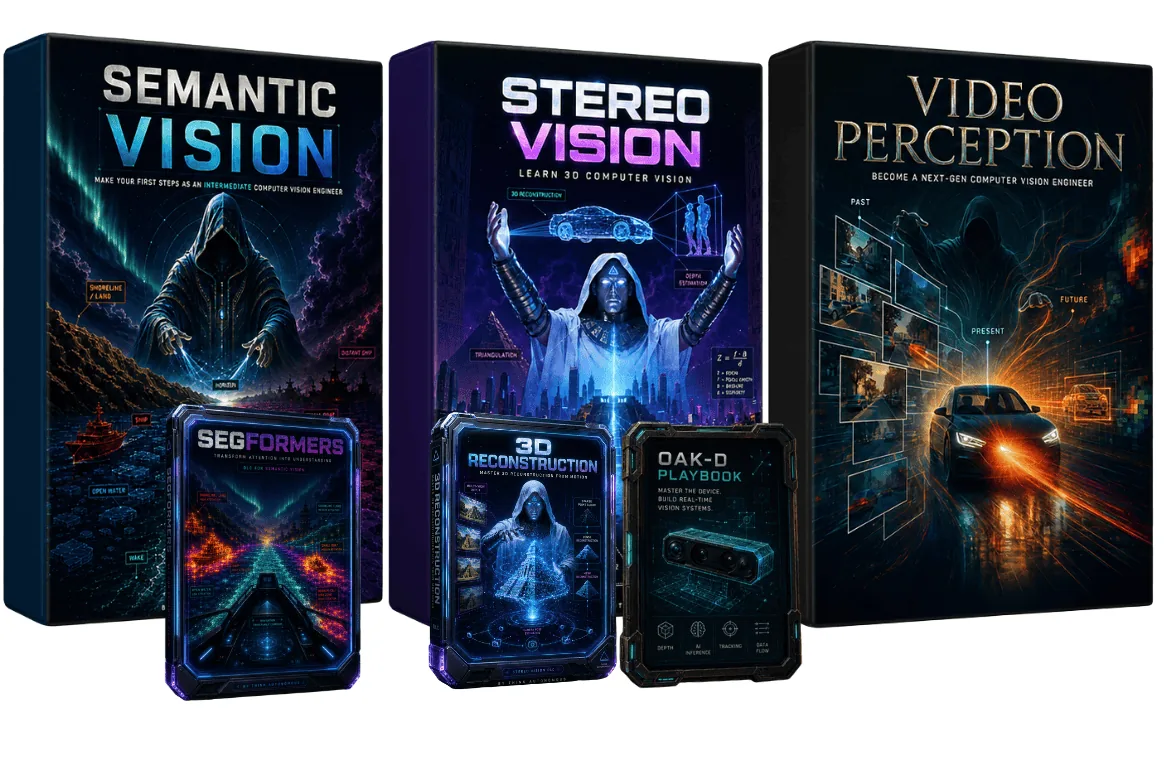
The Computer Vision Pack: Semantic Vision, Segformers, Stereo Vision, 3D Reconstruction, OAK-D, Video Perception

TOTAL VALUE: 1,440€

You've learned a bit of OpenCV here, you took some Object Detection lessons there, maybe you learned some Deep Learning and are following the industry news... but still feels like it's not enough. It's because you may have been focusing on what's now seen as prerequisites, whereas...

To really move the needle, you should focus on the Computer Vision Ladder!

From: Jeremy Cohen
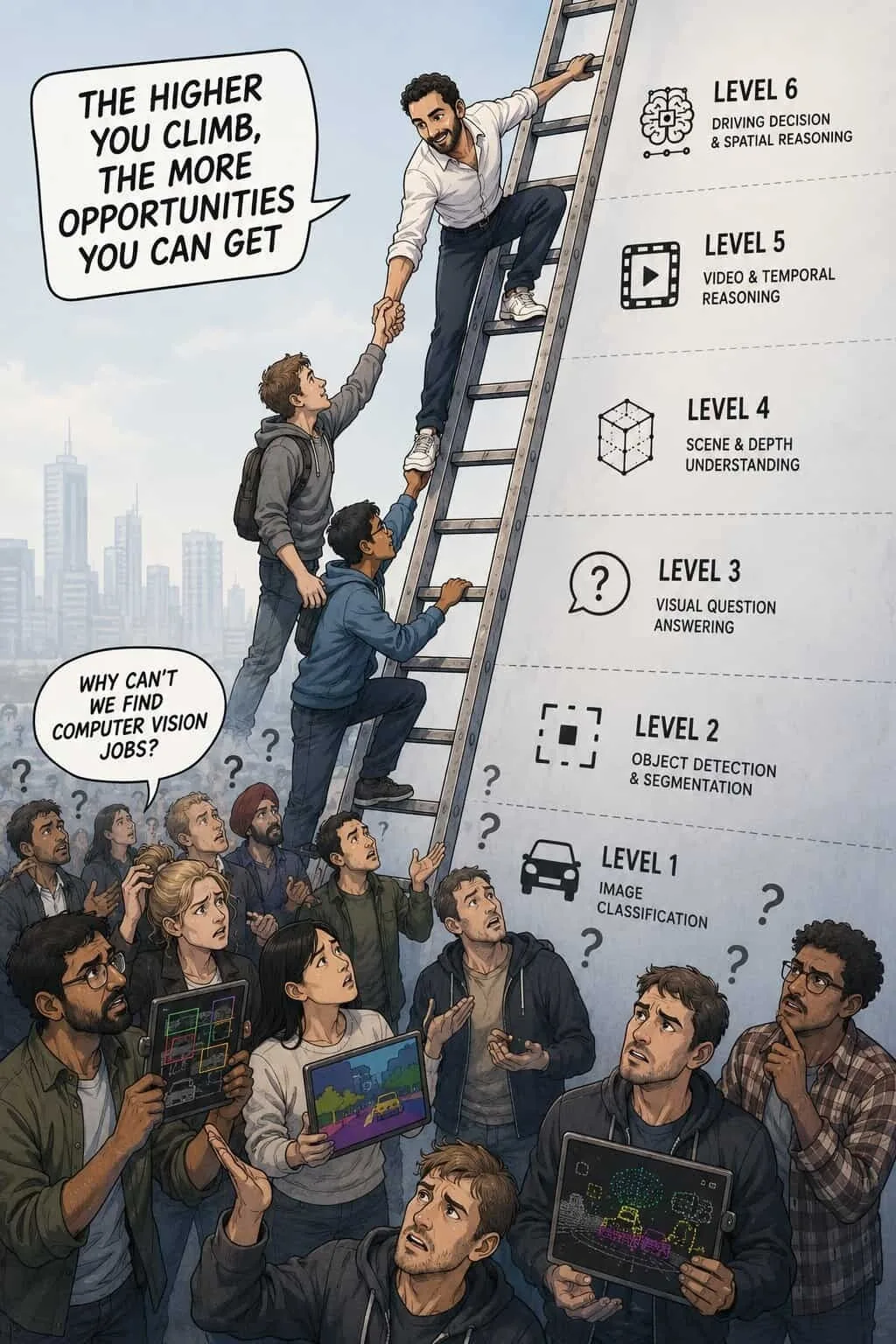
The Computer Vision Ladder: 6 levels from Image Classification to Driving Decision and Spatial Reasoning

Dear friend, if you feel like randomly being pulled in all directions lately, and would like clarity on the exact Computer Vision skills to learn to make it into the field, then this page will show you a concrete path.

Here's the story:

This June, the annual Computer Vision and Pattern Recognition (CVPR) conference set the tone on many topics at the frontier of Computer Vision today: ideas like 3D Reconstruction, World Models, Vision Language Models, or Multi-Modal.

Chances are, most engineers reading this are FAR from that, focusing for weeks on learning skills that do not move the needle. Learning the core ideas behind object detection is interesting, but spending more time than needed on it doesn't grow your career.

So what does? In their CVPR 2026 talk, Intel defined a Ladder of Computer Vision that you can see on the right. It described 6 Levels that every engineer in Computer Vision should reach: Classification, Detection & Segmentation, Visual QA, 3D Vision, Video, and Reasoning.

  1. L6Reasoning
  2. L5Video
  3. L43D Vision
  4. L3Visual QA
  5. L2Detection & SegmentationMost Engineers never go past Level 2
  6. L1Classification

Level 2

Detection & Segmentation

See the course ↓

Click a level

Most Engineers never go past Level 2.

If you paid attention, Level 2 is everything related to image processing: Image Segmentation, Object Detection, Pose Estimation, Keypoint detection, Oriented Bounding Boxes, and even... Tracking.

All of this, while interesting and necessary for every engineer, remains in the realm of Image Processing.

But today, Computer Vision is no longer about Image Processing

That was good for 2017. We evolved. I've interviewed over 20 field engineers working in the industry last year. Many were Computer Vision Engineers, some were CTOs, Director of Engineering of big groups, self-driving car engineers, autonomous robot engineers, even humanoid robot Engineers. Do you want to know what I learned from them?

Today's Computer Vision Engineers are very different from 2017's Computer Vision Engineers. Back then, you were asked to handle tools like PIL and OpenCV very well, you were asked to train YOLO on custom datasets, and to build segmentation masks. This part still exists, but has been swallowed by 3 core skills to understand:

Skill 1

Deep Learning

Not just basic CNNs. This is beyond required. I also mean architectures (encoders, decoders, pyramidal blocks, ...) and Transformers (image, video, multi-modal ...)

Skill 2

3D Vision

Companies today are no longer afraid to go Physical. Understanding camera sensors, not images, understanding 3D, not 2D is what defines the new engineers.

Skill 3

Video Perception

From series of frames to entire sequences... from tracking to reasoning and understanding, video is what gets you to the top of the ladder.

Understanding these skills is what I've been doing for the past decade. First, working as a Computer Vision Engineer for autonomous shuttles. I was building Deep Learning models for drivable area detection. Later on, working on 3D Computer Vision, Spatial AI, and Video Computer Vision.

I have gathered what I learned for over a decade in a series of 6 courses that put together form THE COMPUTER VISION PACK.
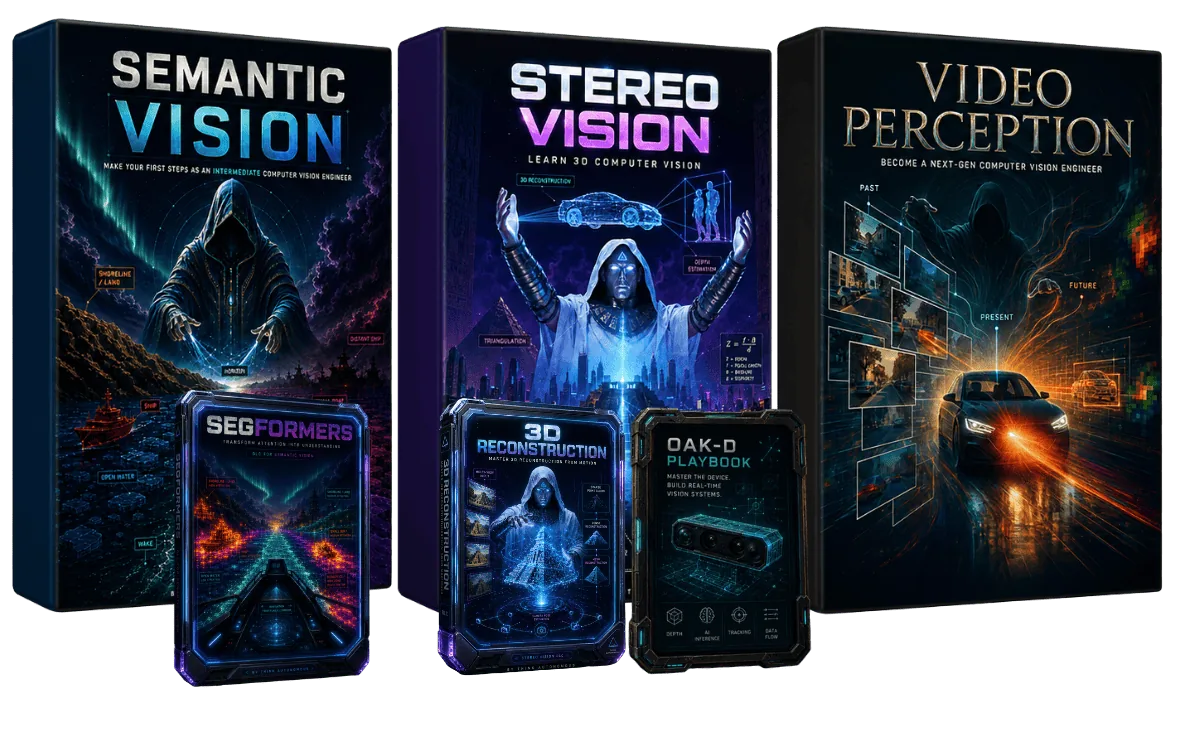

A look inside

WHAT'S INSIDE THE COMPUTER VISION PACK

Deep Learning, 3D Computer Vision, and Video Processing.

01SEMANTIC VISION & SEGFORMERS DLC course cover

DEEP LEARNING FOR COMPUTER VISION

SEMANTIC VISION & SEGFORMERS DLC

The first course is a strong pass through the Level 2 foundations. We can't focus on Level 3 if we aren't sure you got Level 2 right, and that includes all the Deep Learning & CNNs, but also the advanced applications like Vision Transformers, Semantic Decoders, Pyramid Architectures, and more...

In SEMANTIC VISION, you're going to learn how to build custom semantic segmentation architectures. In SEGFORMERS, you're going to build your own Vision Transformer for image segmentation applications.

What you get after taking SEMANTIC VISION

  • Learn multiple segmentation architectures such as UNet, DeepLab, PSPNet, and others... and build them from scratch
  • Understand how to use Segmentation in the robotics / AV world (today, you could get a map in 2 minutes, but using it?)
  • Get a strong understanding of CNNs, Encoder-Decoder Architectures, and Vision Transformers to build strong Deep Learning Foundations
  • Get the complete Vision Transformers 101 course, designed for Computer Vision brains (no text examples, just vision and how pixels turn into attention)
  • Build job-ready portfolio projects using Transformer-based Segmentation (in particular, we'll study the SEGFORMER architecture, which has had many evolutions and is a default today)
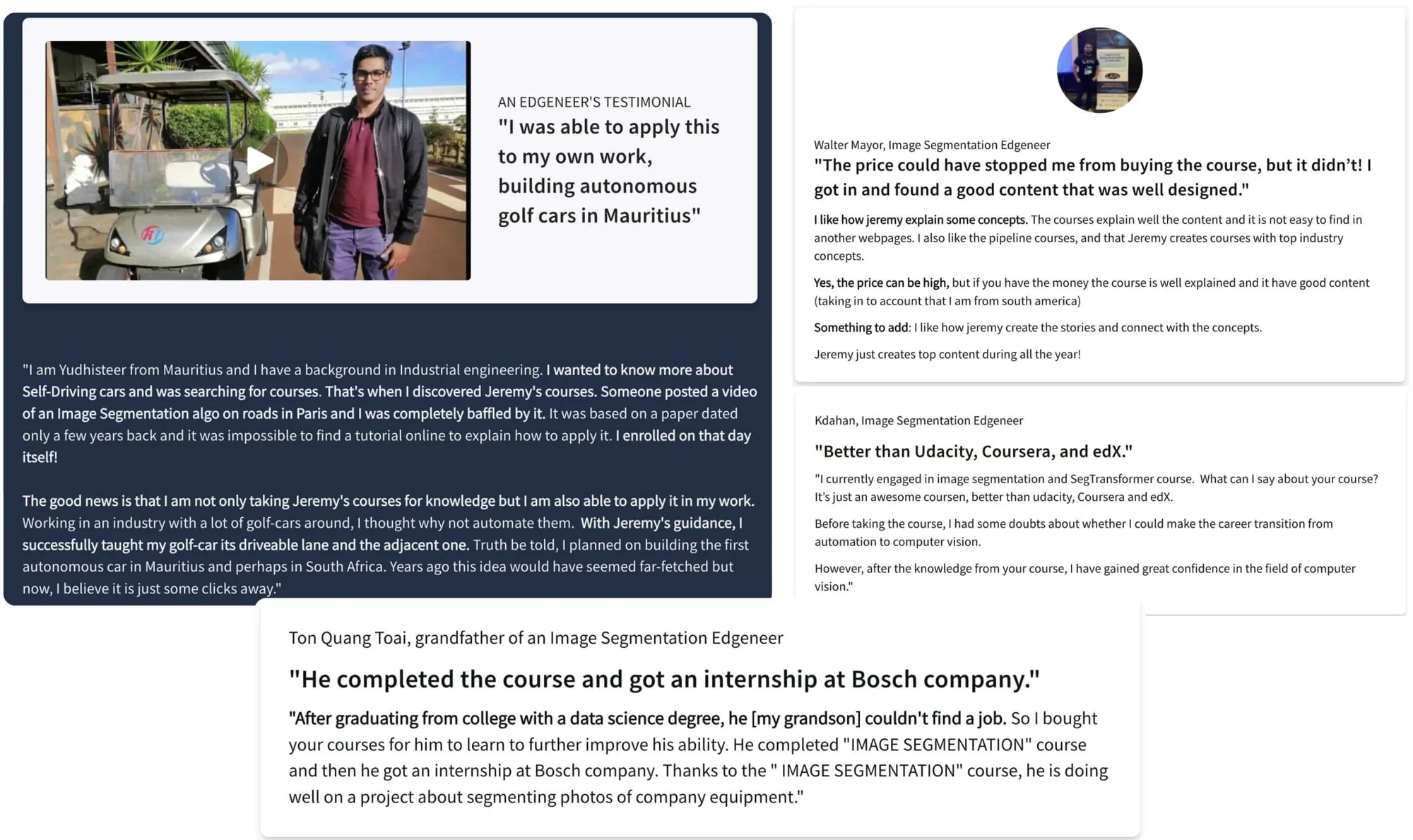
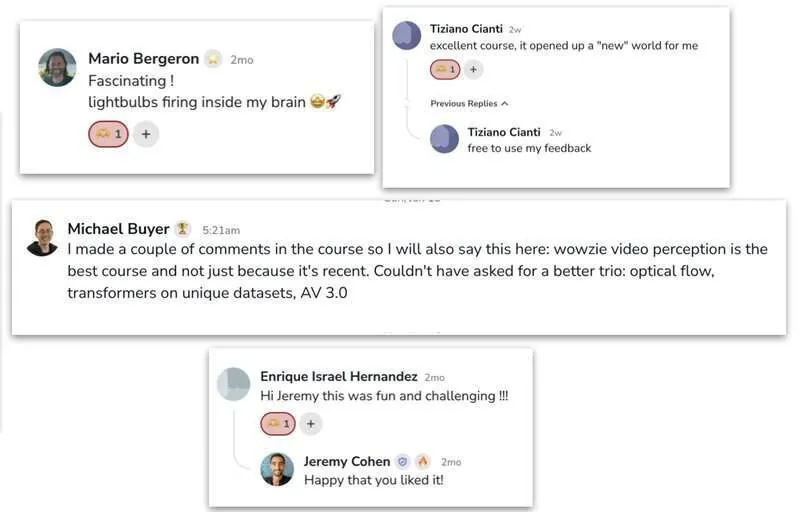
What students say about Semantic Vision
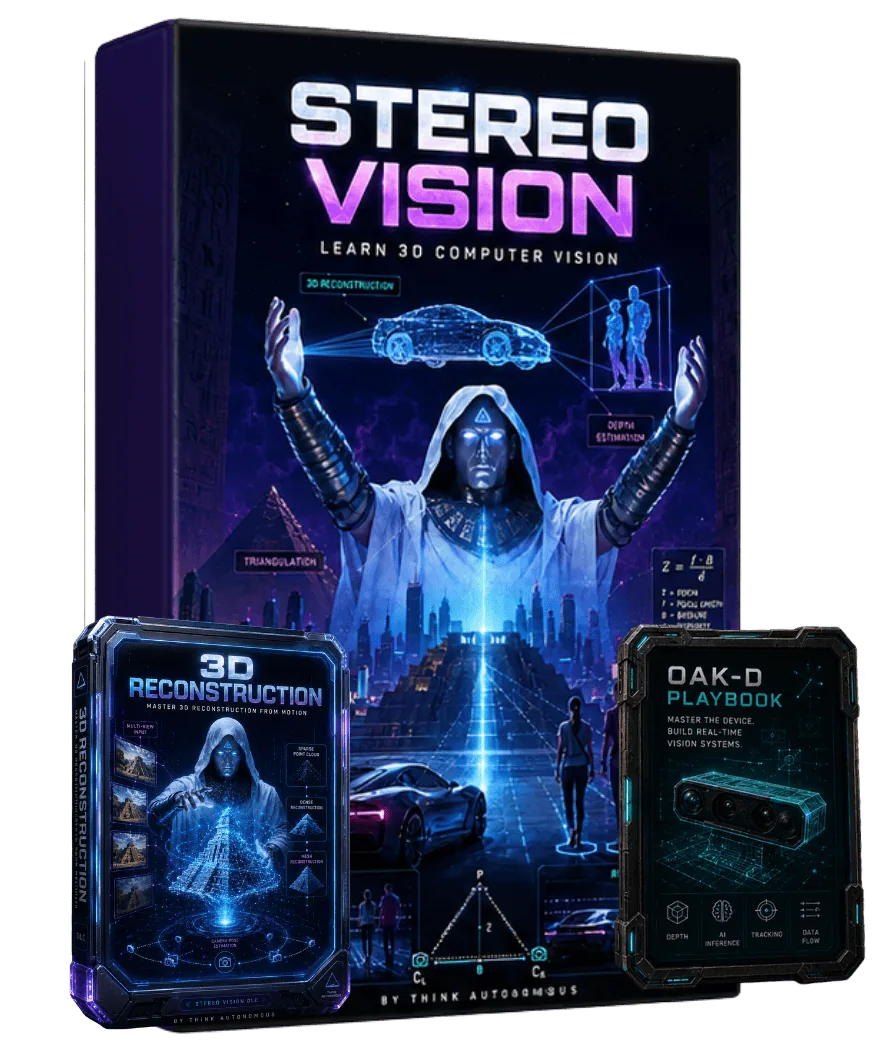
02STEREO VISION - 3D RECONSTRUCTION & OAK-D DLCs course cover

3D COMPUTER VISION

STEREO VISION - 3D RECONSTRUCTION & OAK-D DLCs

Once we've achieved Level 2, we can focus on higher levels. The biggest "lever" you can get in ALL Computer Vision is 3D.

When you learn 3D, you not only understand how to build Depth Maps, Triangulate positions, or Reconstruct point clouds...

You'll also build strong camera foundations with concepts like Homogeneous Coordinates, Epipolar Geometry, or Essential Matrices...

And even build 3D projects like Visual SLAM & Structure From Motion.

What you get after taking the 3D COMPUTER VISION SERIES

  • Upgrade from 2D to 3D Computer Vision by learning the core concepts of Stereo Vision, Triangulation, Depth & Disparity, and so on...
  • Build magnetic portfolio projects in 3D Object Detection, Depth Estimation, Calibration, and more...
  • Get strong mathematical foundations of 3D Computer Vision, so you can defend your knowledge at interviews
  • Transition from Image Processing Engineer to real Computer Vision Engineer (the majority of those calling themselves Computer Vision Engineers actually are image processing ones, we'll get past this)
  • Understand the core ideas of 3D Reconstruction (Structure From Motion, Multi-View) and learn the modern approaches (Gaussian Splatting, NeRFs)
  • Create a profile recruiters stop on and want to talk to
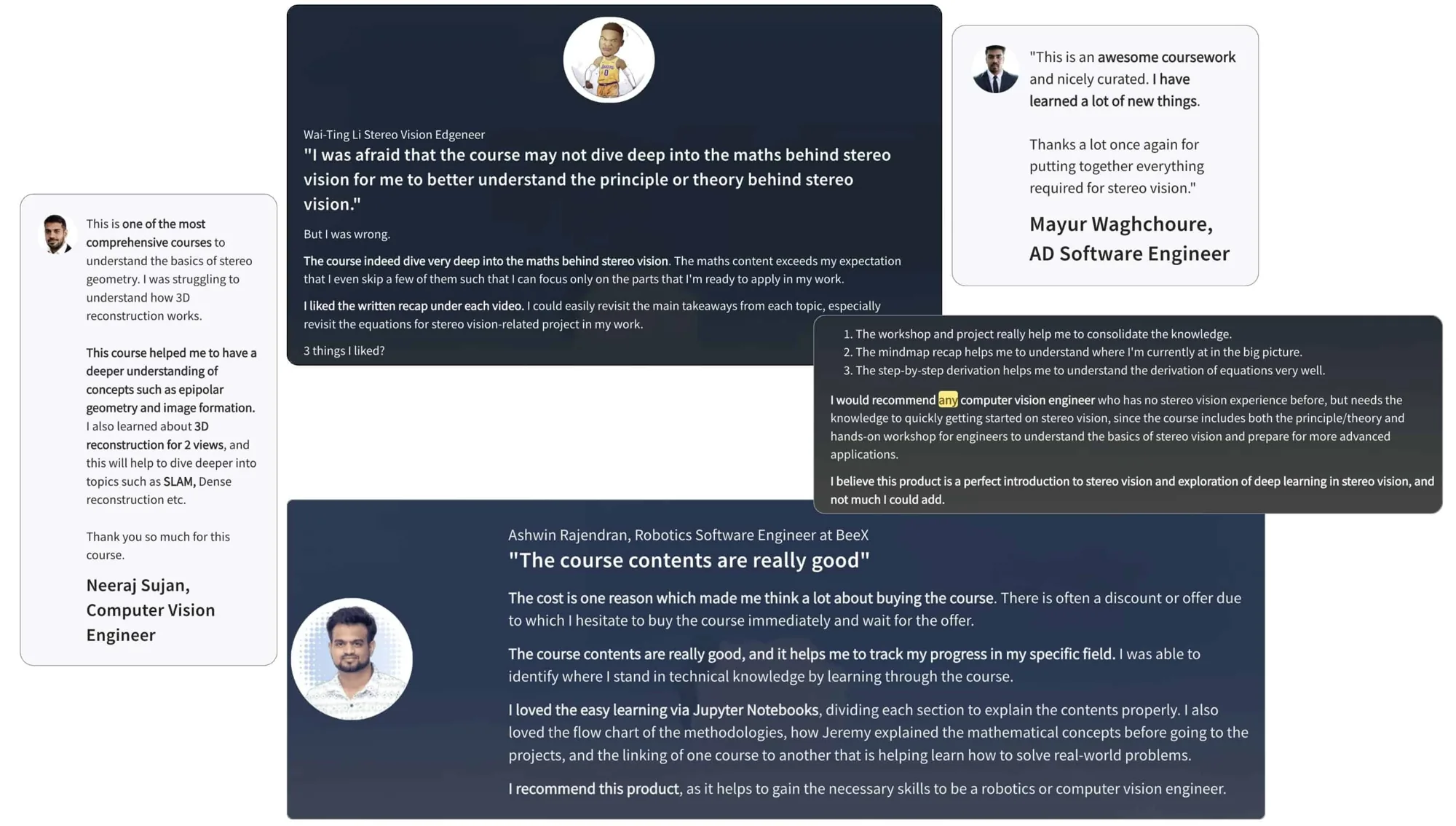
What students say about Stereo Vision
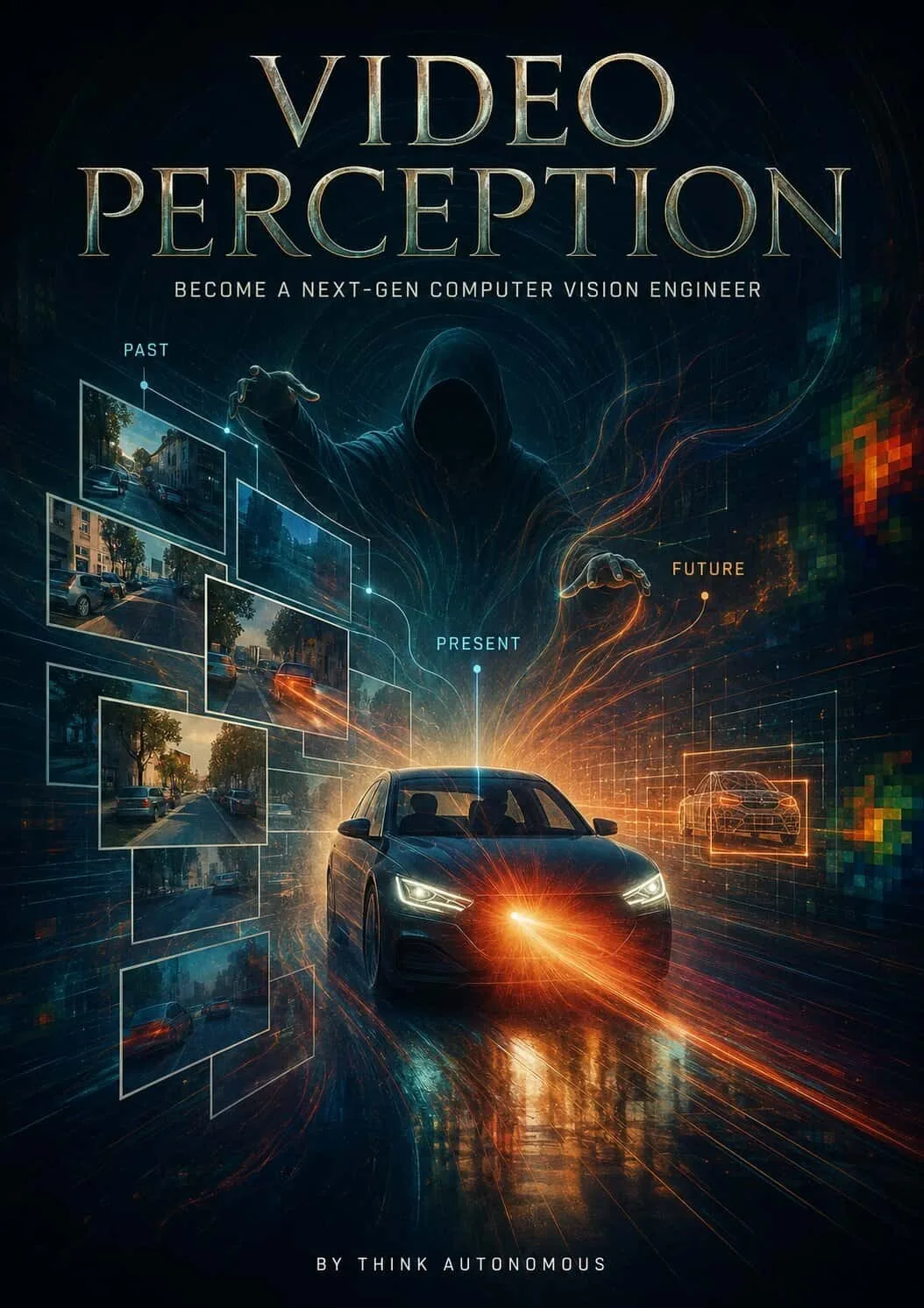
03VIDEO PERCEPTION course cover

VIDEO PROCESSING

VIDEO PERCEPTION

Finally, to get true Computer Vision completeness, you must be in phase with today's market. What are people doing today in the research world? At the frontier inside startups? What do they need inside job offers?

The Computer Vision Ladder says Video QA, Video Processing, and Reasoning. This is what my course VIDEO PERCEPTION covers, with concepts like Optical Flow, Feature Tracking, Vision Transformers, Video Transformers, Chain-Of-Thought Reasoning, Vision Language Action Models, and more...

This final course sets you on the cutting-edge path and achieves your journey in Computer Vision.

What you get after taking VIDEO PERCEPTION

  • Be part of the Elite category of New-Gen Computer Vision Engineers who master Video & Reasoning (most in-demand skills)
  • Build Cutting-Edge Level 5 skills in Video Computer Vision and be able to do things like event detection, activity classification, scene analysis, and more...
  • Build portfolio projects on Shoplifting Detection using Video Transformers (one of the most advanced things you can do in Computer Vision.)
  • Get a complete understanding of Video Transformers and all 5 approaches to do it
  • Understand AV 3.0 and the "Flow" to go from standard approaches to Reasoning, Visual QA, Chain-Of-Thought Driving, and more...
What students say about Video Perception

WHAT'S MY INVESTMENT?

If you go to my website, and check each course one by one, you'll reach a total value of 1,440€, including 498€ for the first series, 597€ for the 3D series, and 345€ for Video Perception.

As it's a bundle discount, the price is only 997€ (or only 4 payments of 295€).

On top of this, for those who want an even more incredible experience, I am giving access to a "Pro Edition", which also grants an Annual Edgeneer Land Membership, plus 2 personalized portfolio project critiques. This isn't just a note on what you'll work on, I'll ask you many questions in advance, help you set a strategy around these projects, and will help you make your project part of a larger plan to build your technical brand. Then, I'll guide you as you take the courses as a "protege", and we'll do another session a few months later. Take this option if you want more strategy, but be ready to be asked to do things you may not think of doing on your own, like contacting certain people, or building specific projects, or orienting your resume in a specific way.

Finally, we also offer the MEGA PACK, which is the best deal you can get, all my courses PLUS a year membership PLUS the 2 portfolio project critiques. The goal? Help you not just get the skills, but also achieve advanced results with them.

Essential

Computer Vision Pack

The Computer Vision Pack
  • SEMANTIC VISION [299€]
  • SEGFORMERS DLC [199€]
  • STEREO VISION [299€]
  • 3D RECONSTRUCTION & CAMERAS [299€]
  • VIDEO PERCEPTION [349€]

Value: 1,440€

Today: 997€

UNLOCK THIS OFFER

* Installments of 3 or 5 payments are available

Pro

The Pro Edition

The Computer Vision Pack, Pro Edition
  • Everything in the Computer Vision Pack [1,440€ value], PLUS:
  • A Year of Edgeneer Land Membership + All Existing Fragments [1,997€ value]
  • 2 portfolio project critiques by Jeremy (ideally set apart in time) [600€ value]

Value: 4,037€

Today: 1,497€

UNLOCK THIS OFFER

* Installments of 3 or 6 payments are available

All In

The Mega Pack

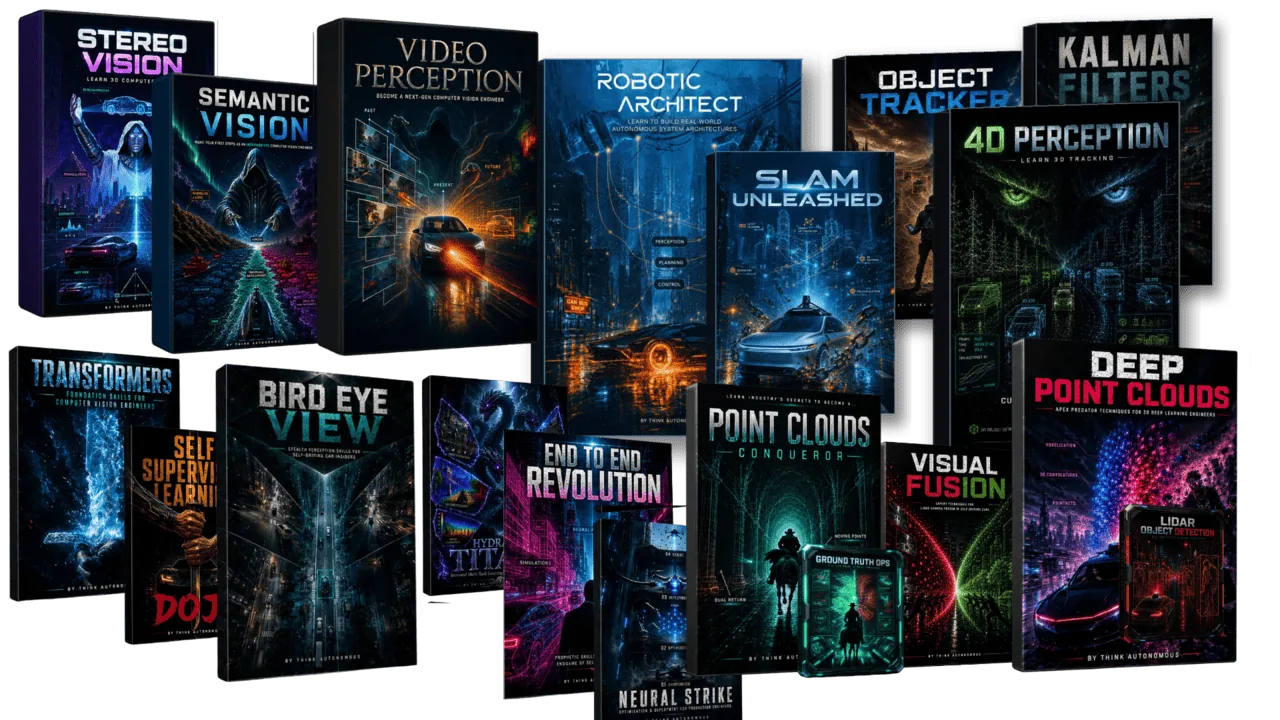
The Mega Pack: every Think Autonomous course
  • Everything in the Computer Vision Pro Pack [4,037€ value], PLUS:
  • The LiDAR Pack [1,441€ value]
  • The Tracking Pack [923€ value]
  • The Robotics Pack [644€ value]
  • The Advanced Deep Learning Pack [1,820€ value]

Value: 8,221€

Today: 3,997€ only

UNLOCK THIS OFFER

* Installments of 3, 6, or 12 payments are available

Questions I got about the Computer Vision Pack

What is the format of the courses?

Each course is a home-study course with immediate access. Each lasts between 5 and 10 hours, depending on if you want to go the quick road and simply understand the skills and build projects, or invest time mastering the craft and building more expertise. Most lessons are text and video based, coming with hands-on projects.

What job does it prepare me for?

Computer Vision Engineer. The pack contains 3 families of skills (Deep Learning, 3D, and Video), and depending on where you spend the most time, you'll get different output.

  • For example, if you spend more time on the Deep Learning part, you'll be able to apply to Computer Vision Engineer job inside big groups or small startups where Computer Vision is a small component. You can think of any robotic startup where Vision plays a part, but not enough to justify 3D or Video skills.
  • If you spend more time on the 3D part, you'll see jobs ranging from Spatial AI, Visual SLAM, or 3D Reconstruction. You can for example find many offers in the defense sector related to drones and 3D.
  • If you spend more time on the Video Perception part, you can also target jobs in the Physical AI space, but also in bigger ADAS groups. Regardless, these skills all come together and benefit each other.
Can I ask you questions if I'm stuck?

Yes, these courses (like all my courses) is hosted on our 2.0 platform, optimized for support, answers, and community learning. You might very well ask questions there and get very quick answers from me or other students.

What are the prerequisites?

This is a Pack which goes from the foundations of CNNs to the advanced part of Computer Vision. All you need is:

  • Coding in Python
  • Knowledge of Foundation Deep Learning (Neural Networks, Backpropagation, CNNs for Image Classification / Level 1)
  • CNNs: We won't recover Level 1 CNNs (image classification, basic MNIST classifiers etc...) so you should know that part
  • PyTorch is a Plus, but what's really required is knowledge of neural networks
Is it really time? Can I afford this right now?

Can you afford to remain static and wondering month after month why the job offers don't reply back? Can you afford NOT to invest in yourself, NOT trying to get a bigger salary, NOT aiming for a higher-level position? NOT going after the high-impact startup?

Nearly ALL Computer Vision Jobs in the US are above 6 figure salary (>100,000$), and most jobs in this industry are the high-tier of salaries. The investment asked is pretty small, especially if you go with the monthly instalment options.