01
UNDERSTAND ARCHITECTURES & SOFTWARE
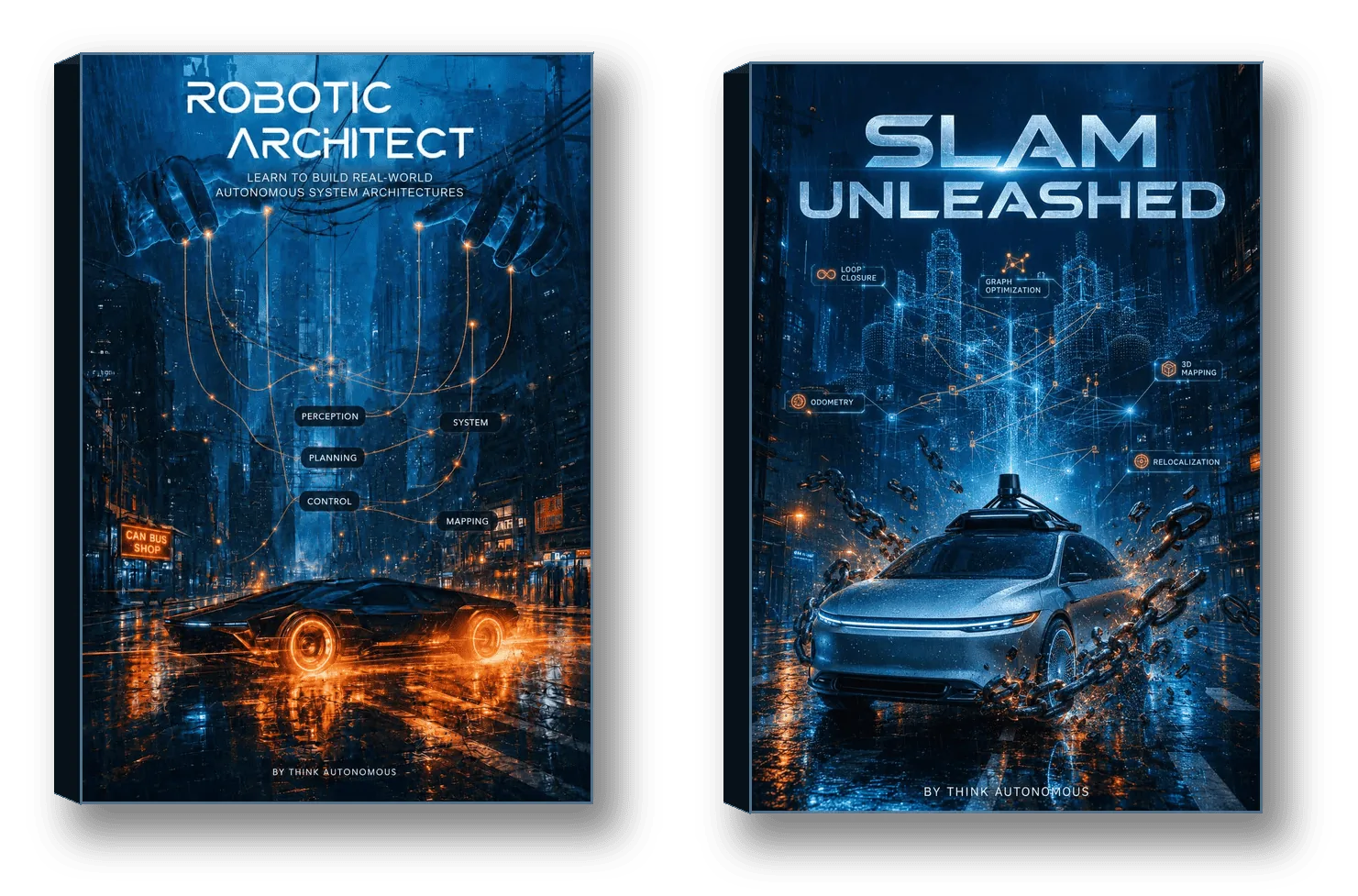
ROBOTIC ARCHITECT
This course isn't just about ROS. Yes, ROS is part of it, because it's so important that I don't even know how I can teach robotics software and architectures without it. On top of that, I believe every engineer interested in robotics MUST learn how to use ROS. So we'll see it.
But more importantly, we'll discuss software and how to build architectures for autonomous robots.
What you get after taking ROBOTIC ARCHITECT
For example, you will learn:
- An introduction to ROS and the core things you should know about it (in this part, we'll see a self-driving car version of what tutorials do when they get you to create packages, nodes, topics, launchers, etc... but with a more concrete example)
- How to export your algorithms to ANY ROS system (it can be Object detection, LiDAR Perception, HydraNet, 3D Tracking, ...in this part, we'll talk about the ROS Client Library, Subscription to Camera and LiDAR sensors, synchronization, messaging, and more)
- Exactly how much you need to know about ROS to become a self-driving car engineer, and a checklist of things you should know before applying for a job
- What is "hard real-time" in self-driving cars, and how to technically "pass" the regulator's requirement of computations, real-time, memory, security, and more...
- What is a deterministic system, and how to make stochastic systems deterministic (and thus comply with regulation) (This may lead us to more Black-Box systems like End-To-End Learning, and why they may be problematic in a real-world environment)
- What is Earth's geomagnetic field and how it can impact the development of a self-driving car localization module (hint: because Earth's magnetic north pole moves every year, this affects our compasses and GPS measurements, this means that a Localization module built 10 years ago could fail today, we'll see how to anticipate for this)
- The 6 files used by DDS to cyber secure a self-driving car's communication systems, and what they mean
- An introduction to Docker for Robotics, and the minimal knowledge you need to build in order to "pass" (we'll also do a full analysis of a Dockerfile, and learn exactly how to build a Docker Image with Robotic OS installed)
- Project #1: Implementing YOLOv8's Segmentation & Detection HydraNet on ROS: we'll see how to clone a Github repository that is NOT built for ROS, and make it ROS compatible (we'll actually see two ways to do it: a dirty but working one, and a more professional and robust one)
- Project #2: Engineer a LiDAR to Bird Eye View perception visualizer. We'll see how to process LiDAR point clouds and turn them into Bird Eye View images (incidentally, we'll also see that this can then be processed by 2D CNNs for 3D object detection)
- Project #3: Implement a 3D Sensor Fusion system that uses an Extended Kalman Filter to fuse an IMU and GPS and accurately locate on a map
It's far from over, for example, you'll also do something called the "Architecture Breakdowns": you'll get to study REAL architectures from self-driving cars in production today, and even read their code and how they work.
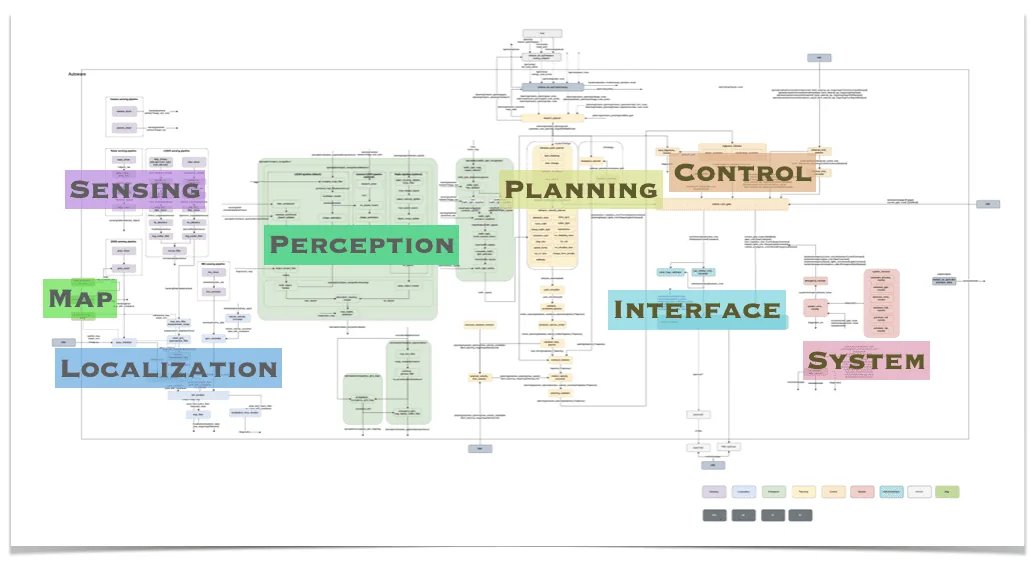
A deep dive into Autoware's Node Diagram and C++ code (we'll see every algorithm they use to implement a real self-driving car thousands use in production)
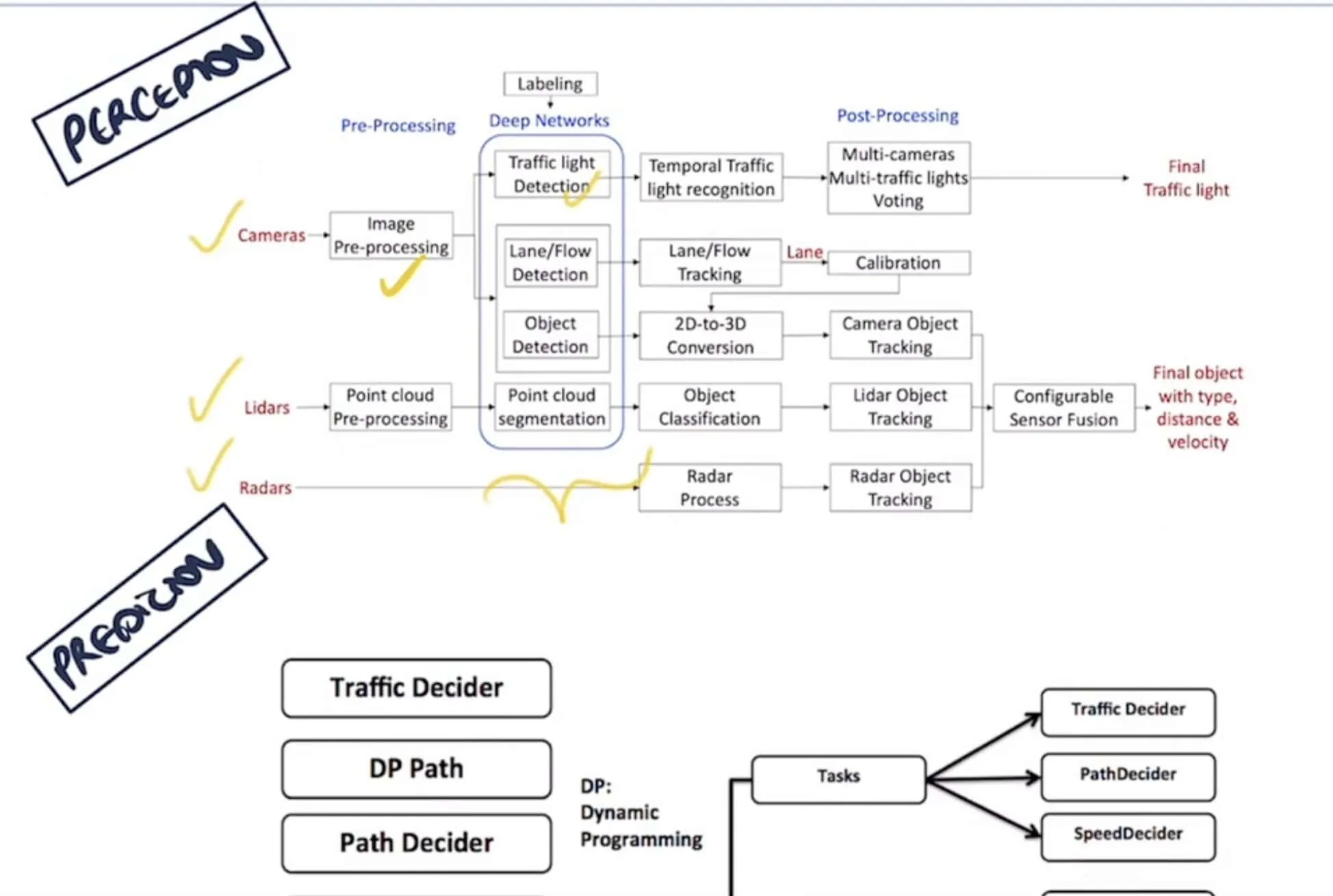
The story of how my team used Apollo Auto and Cyber RT on an autonomous shuttle, and every step we had to go through to Deploy Apollo on our own Autonomous Shuttle (CyberRT is an equivalent of ROS fitted for self-driving cars, because we will understand middlewares better, we'll be able to study it much faster)
And of course, you'll also see "Pro" stuff, like:
- What is RTOS (Real-Time OS), and why self-driving car companies are crazy about using it in their architectures (warning: RTOS is a different OS that has the power to make your software achieve "hard real time", handle with care)
- Exactly how much you need to know about ROS to become a self-driving car engineer, and a checklist of things you should know before applying for a job
- An "on the fly" analysis of 5 Robotics Software Engineer Job Offers, and the 3 hard skills every robotic engineer needs to have (I have been able to verify this information while giving a seminar in India and confirming that ROS was at least one of the skills everyone had)
- The differences between ARM and AMD computing architectures, and why the world is slowly transitioning to ARM (we'll also see it in the context of Docker, and see a command to create a Docker container for ARM environments)
- An exclusive look into GPS and EKF Localization for self-driving cars, and how to "GPS MAP" an environment to identify possible blind spots (we'll also see how to tell apart a Russian GPS from an European GPS, and talk more about quality of signals)
- How to make ROS faster by removing ROS (hint: ROS is a high-level API, we can get rid of some useless components, and only keep the lower level communication protocols)
- An introduction to DDS (Data Distributed Service), the true middleware behind ROS 2, and a detailed analysis of all its components
- How to change the middleware of ROS, and use low-level command lines to ensure a higher quality of service, security, and prevent failure, crashes, and random bugs
- What to do if you join a company that uses a different ROS version than yours, and the untold story of a Robotics Engineer who joined a Robotics company and discovered that both ROS 1 and ROS 2 were used (while it may look like ROS is now ROS 2, 80% of companies are still on ROS 1, and a good 99% of them use both ROS 1 and 2)
- Why it can be a terrible idea to implement a centralized architecture with every sensor pointing to the same computer, and 2 alternative sensor designs you can use instead
- And many more...