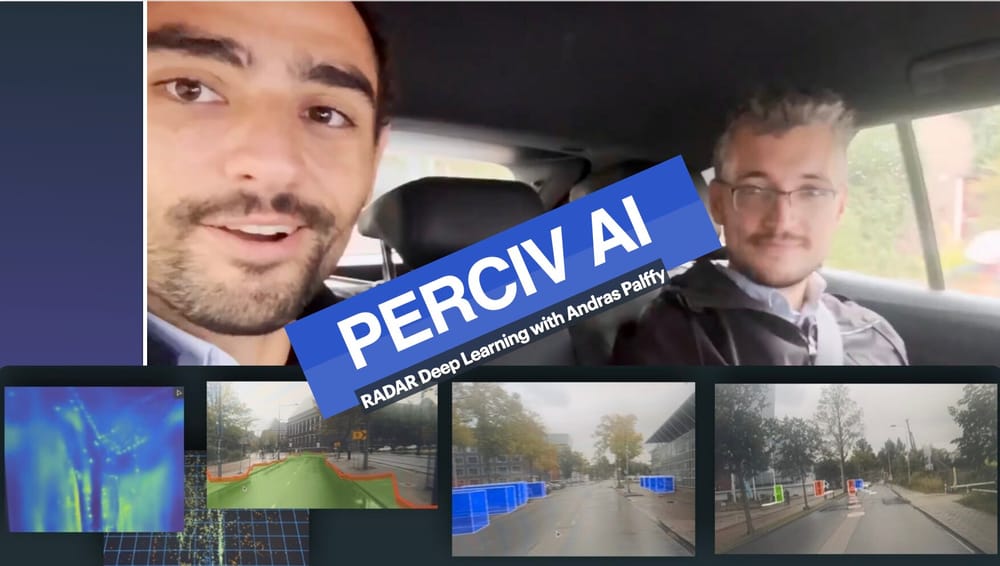
Perciv AI: The Power of RADAR Deep Learning with Andras Palffy
Ever done a "house swap"? Recently, one of my mentors in Canada told me he was swapping homes with someone in the Netherlands. Sounds unreal... Yet it isn’t. Platforms like Home Exchange apparently have 100,000+ members doing exactly this.
House swapping is one of those things that could never have worked a decade ago. Not because the idea was bad (I think it is, but that's different), but because trust, norms, and infrastructure weren’t there.
And RADAR Deep Learning follows the same pattern.
RADAR has existed for over 100 years. Most RADAR algorithmic is still traditional signal processing. As a result, RADAR engineers have long been a small, almost outcast group of "freaks" (sorry) working on systems few people truly understood.
Why? Because for decades, RADARs were treated as a secondary sensor. Too noisy. Too low-resolution. Useful only as an auxiliary input in sensor fusion, under the assumption that even noisy measurements are better than nothing.
That assumption is now breaking.
RADARs are moving into a primary sensor role:
- high-resolution RADARs exist
- imaging 4D RADARs are spreading (see my article here)
- And more importantly, DEEP LEARNING is now so capable that processing even noisy point clouds can be done!
This is why in this episode, I am boarding a train to Rotterdam, where I am meeting with Andras Palffy from Perciv, a startup focused on RADAR Deep Learning.
The name is Palffy. Andras Palffy. This machine perception and AI specialist co-founded Perciv, a Rotterdam based startup focused on AI for RADARs. He wrote multiple 3D Deep Learning papers, and got his Ph.D at the TU Delft (Netherlands).
He's today running Perciv, and I'm going to show you an amazing video of his work...

WOW!!! So cool, isn't it? Now, in this post, I will cover 2 ideas to explore:
- The process of Deep Learning for RADARs (how does it work)
- The applications you can do when leveraging 4D Deep Learning
Let's begin with the process:
How to make Deep Learning for RADAR work
Let's begin with this post showing you a demo of Perciv AI's algorithm:
Can you feel the power? This video shows object detection, but what's very interesting is how noisy the input is! The points are "dancing", unlike most LiDAR point clouds, which are much more robust and accurate.
Yet, RADARs provide direct velocity estimation, via the Doppler Effect, making them very interesting sensors to use.
So how does it work? It's really 3 steps:
- A RADAR outputs a raw signal.
- This signal is often converted to a 2D or 3D point cloud to be processed.
- 3D Deep Learning algorithms are working on the point clouds with points or voxel approaches, just like for LiDARs.
Now the interesting element:
Most traditional RADAR algorithms skip step 2, because they process the RADAR signal directly (you can see how in this article). In the case of Deep Learning, we have the option to either convert to a point cloud OR process the raw signal directly. This means that step 2 (signal → point cloud conversion) can be skipped, which avoids losing data during conversion.
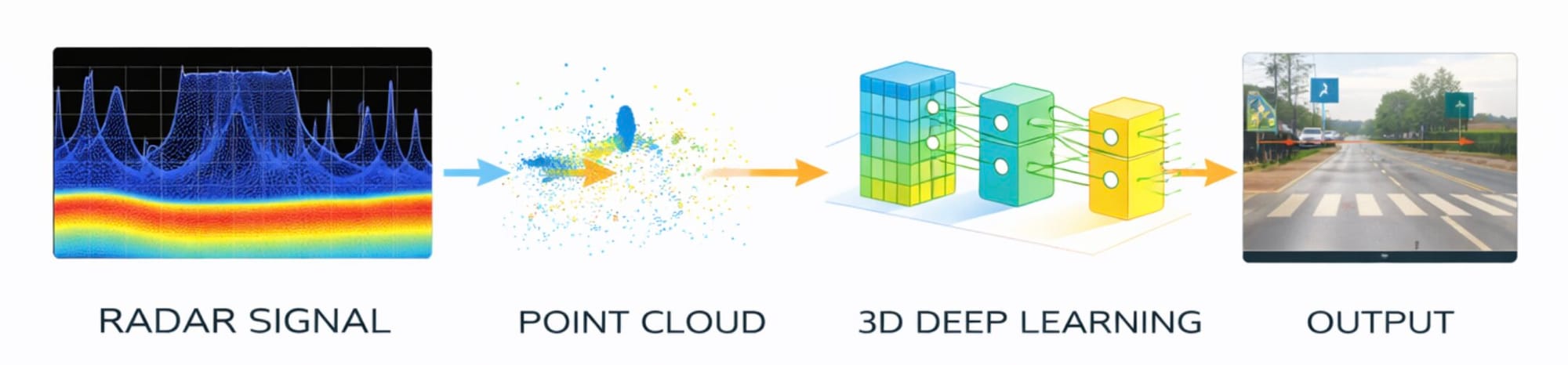
We now get the general idea: Thanks to Deep Learning, we can make noisy RADAR data useful. The next question is, what exactly can we do?
Applications of Deep Learning for RADARs (By Perciv)
Here is a 30 second clip I recorded at Perciv going in-depth of the sensors, algorithms, and end-user interface.
What's possible using Deep RADARs
Let's begin with the sensors. Did you count how many there were? I see 1 camera, 2 LiDARs, and one RADAR that has 2 views: a point cloud view, and a range-doppler view. If you zoom in, you'll see that the RADAR point clouds are absolutely chaotic. There is no way you'd make sense of it.
And yet, when you see the blue part, in the middle of the video, you see what the Deep RADAR algorithms are capable of. The algorithmic panel is ALL based on the RADAR input only. And notice how awesome they are, we have:
- LiDAR + RADAR Accumulator
- RADAR Heatmap
- Freespace Detection
- 3D/4D Object Detection and Perception
Seriously...
A freespace detector... on a RADAR!
This is really impressive, isn't it? And it's not ALL, because later on, Perciv AI showed me a side-by-side comparison of SLAM with RADAR and LiDARs. Can you guess which one was superior?
Here's the answer:
While the RADAR Odometry uses the velocity information and can accurately spot moving points, LiDAR doesn't, and as a result, overshoots!
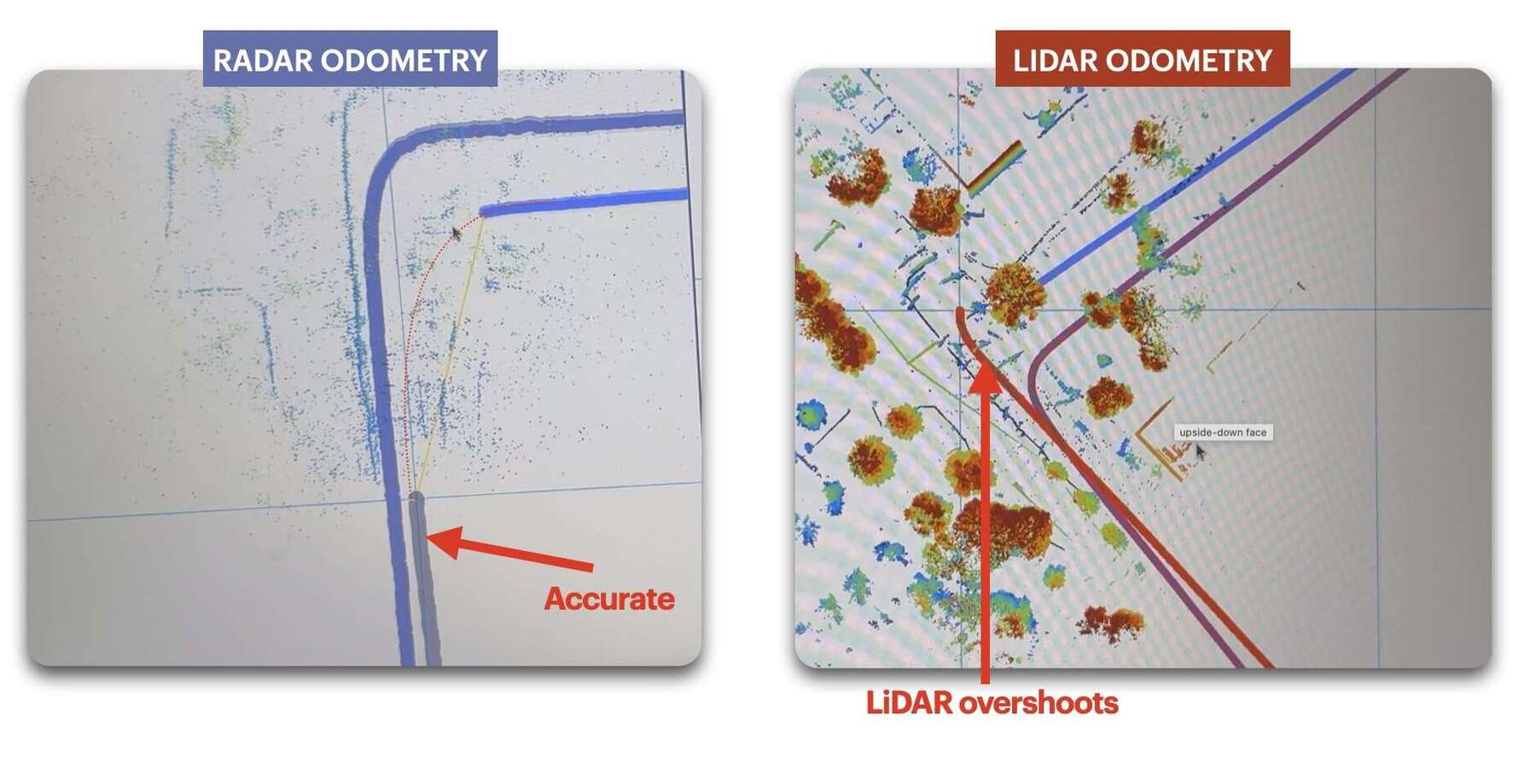
This is a very good example of how Deep Learning for RADAR can be used for advanced applications.
Summary
- Perciv AI builds Deep Learning for RADAR algorithms and they are awesome. I've been following Perciv since 2023, even interviewed them when they were only 3, and their dedication to this field is unmatched.
- In RADAR processing, you can either process raw signal, or convert it to a point cloud the same way you'd do with LiDARs. A heavier pre-processing step is usually done to reduce noise.
- The RADAR processing pipeline therefore becomes: signal → point cloud → 3D Deep Learning algorithms → output
- There are many algorithms you can run on RADARs, from object detection to SLAM. In some cases, RADAR's velocity information can even provide BETTER results than LiDARs.
Infiltrate Perciv AI with me?
The last time I visited Perciv AI, I got a complete tour of their facility, team, 4D Deep RADAR algorithms, and even self-driving car. I got to live as an intern on his first day of a self-driving car startup.
I'm thinking...Wanna see what it's like? I mean, what I'll record there will obviously be top secret, guarded and accessible ONLY to the Edgeneer's Land citizens (my community membership)....BUT the show?
This is a show they just did at IAAA Munich to everybody. And I see no reason why everybody shouldn't discover it. This is why I'm creating a special 2-day Virtual Tour, in which you'll be able to come with me in Rotterdam, be a fly on the wall, and get to live your first day as a self-driving car intern...You will see things like:
- ✅ Their self-driving car — if you never saw a self-driving car before, this will be the closest you'll ever get, we'll see the sensors, wires, everything
- ✅ Their 4D Deep RADAR demo — where they will demo their algorithms on me!
- ✅ Their RADAR tour — where they'll show you what is a RADAR, and give you a tour of the different types in the market
- ✅ The RADAR vs LiDAR SLAM video — explaining the differences in Odometry estimation and how to do a clean one using RADARs
As I said, this is the public stuff you normally CAN'T see unless you physically move to where they are. For 99% of people reading this, this is a unique chance to see it. Interested?