How RADARs work - A look at Radio Detection And Ranging
Several years ago, I was in Cannes with my wife and in-law family, when a terrible event happened. We were getting out of the restaurant, walking on the street down towards the famous "Croisette", when suddenly... **BANG**. A loud bang got heard. Seconds later, hundreds, if not thousands of people were rushing towards me.
I had very little information to process what was happening, but movement alone told me I had to RUN IN THE OPPOSITE DIRECTION. Unfortunately, not all of us processed it the same way. My father in law stayed static. I was there "We gotta move! NOW!", and he was standing still, forcing all of us to face the huge human wave coming towards us.
Nobody got hurt. We managed to get inside a building, let the crowd pass. Then, 2 hours of extremely intense hiding. I remember it, we thought terrorists were shooting at us. Twitter was reporting the Carlton hotel being hijacked, hundreds of death. Police sent messages telling everyone to avoid the streets and lock the doors.
All of that was nothing. 2 hours later, we got out. And the story never made the day. We never learned what truly happened. It surely wasn't terrorists like Twitter was saying.
In this story though, something interesting happened: we all analyzed danger because of movement. Had the people been static, even if everybody yelled, nobody would have run.
RADARs work the same way. They aren't the sensors you want to use on static scenes, but they are EXCELLENT at catching movement in a scene, identifying the speed of every moving object, and even, in some case, going through objects.
In this post, I want to dive into how RADARs work, help you understand why and when to use it, and help you understand the core ideas of RADAR Detection And Ranging.
Let's begin...
Why RADAR is useful
If you've been following the self-driving car space for a while, you've probably noticed something. Everyone talks about LiDARs. Everyone talks about cameras. Almost nobody talks about RADARs.
And it's not because RADARs don't matter. It's because they're hard. Cameras give you an image you can look at. LiDARs give you a point cloud you can visualize. A RADAR gives you a signal, and unless you know signal processing, that signal means nothing to you.
Andras Palffy, who I interviewed in Rotterdam for my episode on RADAR Deep Learning, summarized it better than I ever could:
LiDAR: easy to understand, easy to work with, super expensive. RADAR: hard to understand, hard to work with, and actually quite cheap.
That last part is what makes it worth your time. A RADAR costs a few hundred dollars, not tens of thousands. It fits behind the front bumper of a car you already own. And it does things no other sensor on the vehicle can do.
It works in rain, fog, snow, and total darkness, when cameras are blind and LiDARs start to struggle. It measures the velocity of a moving object directly, instead of inferring it across multiple frames. And it can even see underneath and around obstacles, which means it can warn you about an accident happening a few cars ahead, before you can physically see it.
So yes, RADAR is harder to learn than the rest of the sensor stack. But that's exactly why understanding it makes you valuable.
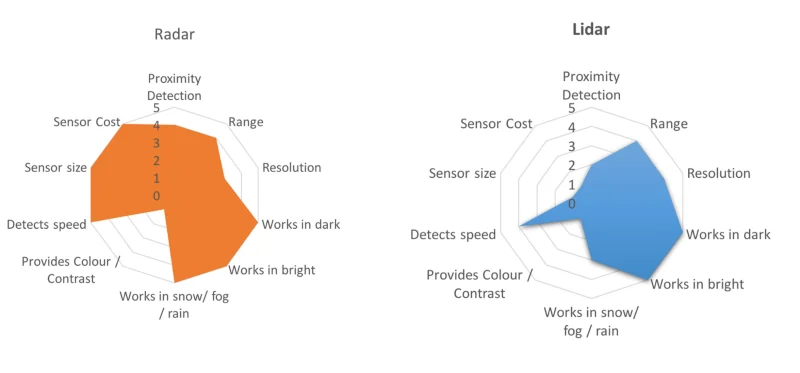
To sum up the picture, RADARs can measure the velocity of an object directly and can work during different scenarios such as day, night, rain, fog, snow… while other sensors may be troubled.
How RADARs work
Introduction
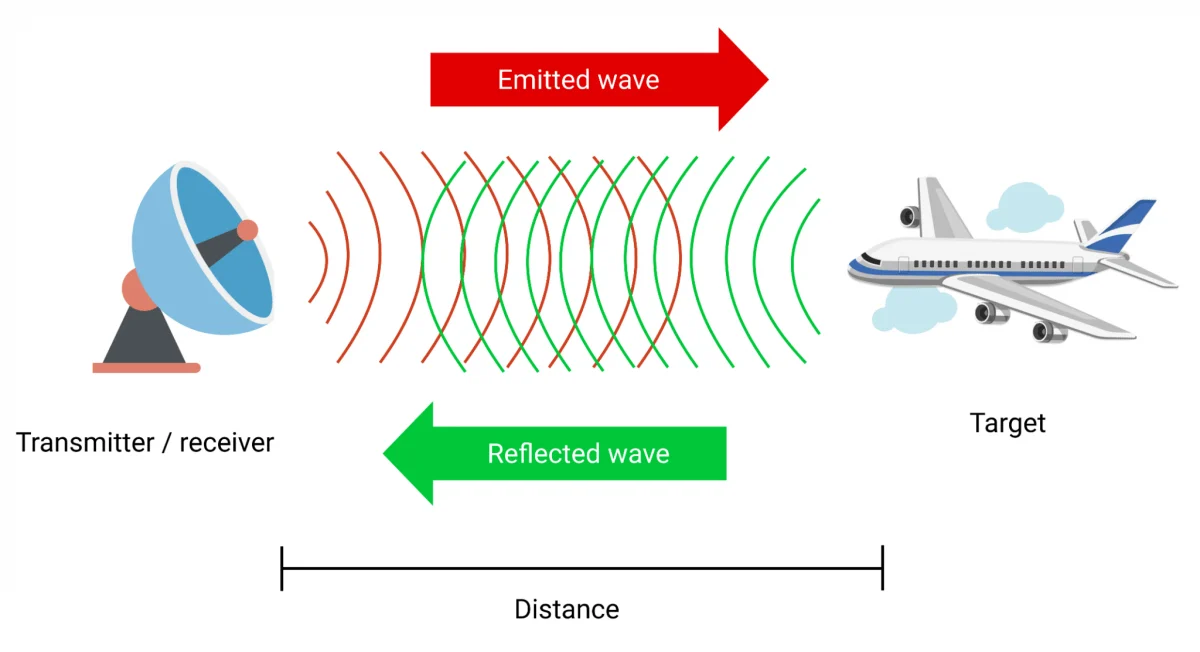
RADAR stands for Radio Detection And Ranging. It works by emitting electromagnetic waves that bounce back when they hit an obstacle. Since these are radio waves and not light, they go through rain, fog, and darkness without caring.
But here is the part that confused me for a long time. A RADAR doesn't "see" anything. It sends a wave out, it gets a wave back, and that returning wave is all it ever gets. So the entire job of a RADAR is to look at how the wave came back, and deduce what happened to it out there.
And this is where it clicks. Every property of that returning wave tells you something specific about the object it hit:
- The time it took to come back tells you how far the object is. This is the range.
- The change in frequency tells you how fast the object is moving toward you or away from you. This is the velocity, and it comes from the Doppler Effect.
- The strength of the returning signal tells you something about the object itself, its size, its shape, and what it's made of. This is the RADAR Cross Section.
- The direction the wave came back from tells you where the object is positioned, left or right of the sensor.
That is the whole mental model. A wave leaves, a wave returns, and by measuring 4 things about that returning wave, you reconstruct where an object is, how fast it's going, and roughly what it might be. Everything else in this article is just the details of how we extract those 4 measurements.
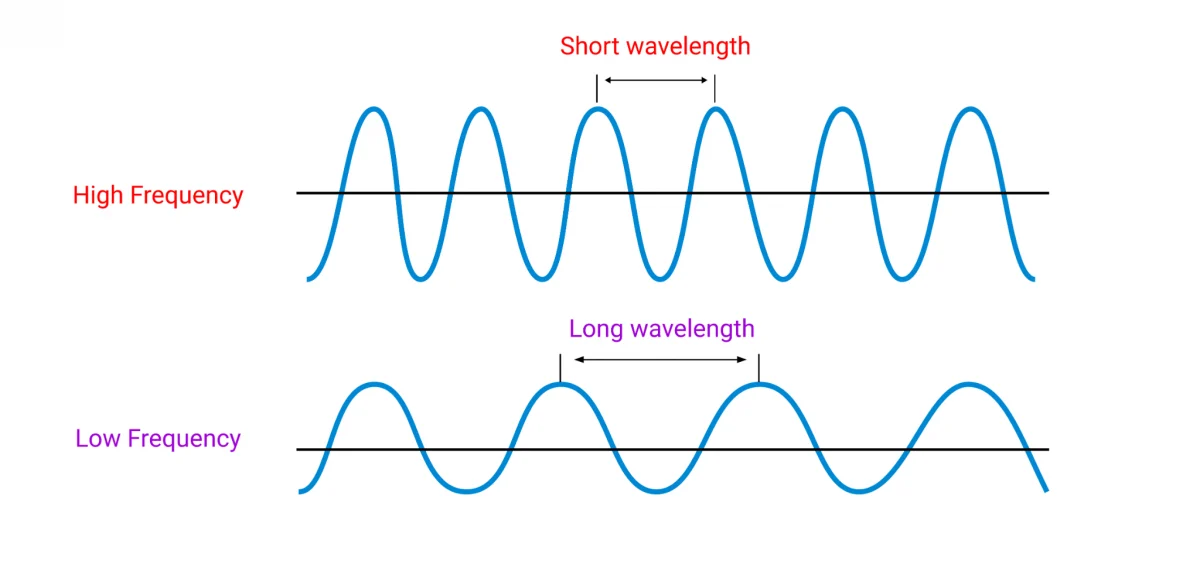
So before we go further, keep this in mind. Every wave has a wavelength, a frequency, an amplitude, and a phase. These aren't abstract physics terms here, they are literally the raw material we use to build a perception system.
Visually, it looks like this:
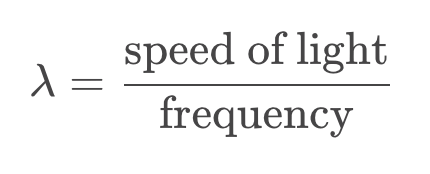
And a quick reminder on the vocabulary, because these two words come back constantly. The frequency is how many times the wave oscillates per second, and the wavelength is the physical distance between two peaks. They're inversely linked: high frequency means short wavelength, low frequency means long wavelength.
Now, let's look at the hardware actually sending those waves...
The wave itself (FMCW)
One quick detail before we measure anything. The RADAR in a car doesn't fire one short pulse and wait. It emits a continuous wave whose frequency constantly ramps up, then resets. That ramp is called a chirp, and on a graph it looks like a sawtooth.
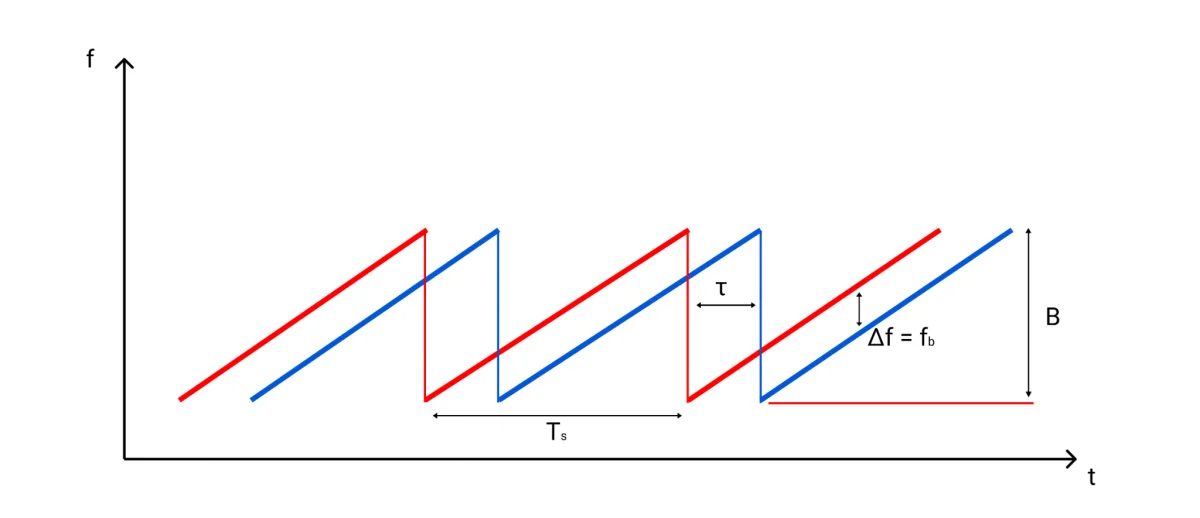
Why does this matter? Because the frequency is always changing in a known pattern, the wave coming back is a slightly older version of the wave going out right now. Compare the two, and the gap between them hands you the round-trip time and the frequency shift at once. That's how one sensor measures distance and speed simultaneously.
The hardware doing this is simple enough: a synthesizer creates the chirp, an amplifier pushes it out to 300 meters, an antenna sends and receives, a mixer compares the two frequencies, and a processor runs everything on top.
Now let's extract our 4 measurements.
Measurement 1: How far is it? (Range)
This one is pure timing. The wave travels at the speed of light, so if you know how long it took to come back, you know how far it went.
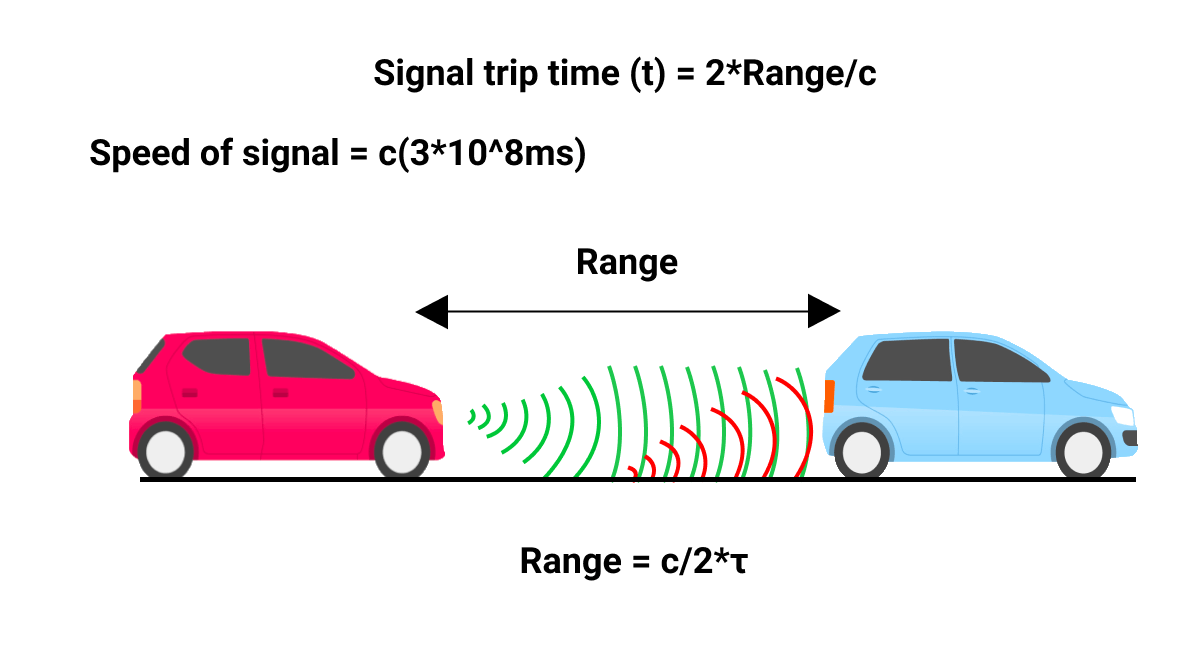
The signal makes a round trip, so you halve the time. Range = c × T / 2. That's it. No neural network, no training data, just a stopwatch and a multiplication.
Measurement 2: How fast is it going? (Doppler Effect)
You already know this one, it's what gets you speeding tickets. It's called the Doppler Effect.
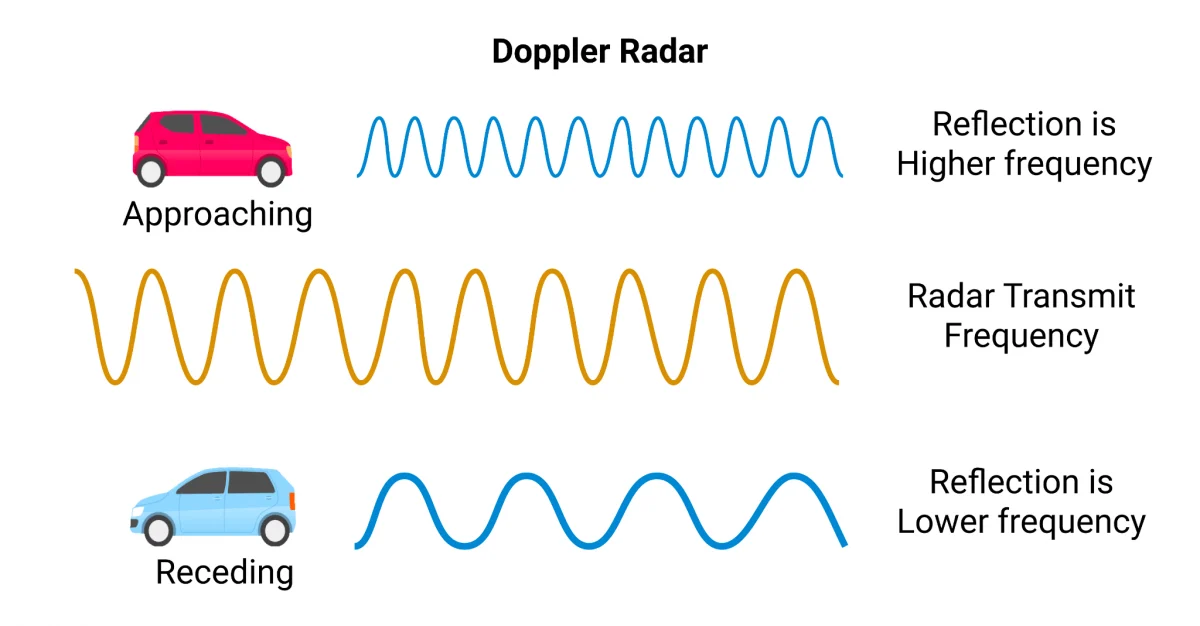
The middle wave is what the RADAR sends out. The top one bounced off a car coming toward us, and got squeezed. The bottom one bounced off a car driving away, and got stretched.
That squeeze or stretch is a measurable shift in frequency. Read the shift, and you get the speed of the vehicle and whether it's approaching or leaving.
This is RADAR's superpower. A camera or a LiDAR compares several frames to guess a speed. A RADAR reads it off a single measurement, instantly.
Measurement 3: What kind of object is it? (RADAR Cross Section)
Now we use how strong the returning signal is. Because not every object bounces a wave back the same way, and that difference is captured by a metric called the RADAR Cross Section, or RCS.
It depends on 4 things: the geometry of the target, the direction of the RADAR, the frequency, and the material the object is made of. A big flat metal truck reflects a lot. A pedestrian reflects very little.
The extreme example is the stealth aircraft. Angled surfaces deflect the waves away, a smooth body avoids scattering them back, and the paint absorbs whatever is left. The goal is to push the RCS to zero, so the plane never shows up at all.
Measurement 4: Where is it, left or right? (Angle of Arrival)
The last measurement is the simplest. A RADAR doesn't have one antenna, it has several. When a wave comes back, it hits those antennas at very slightly different moments.
That tiny difference tells you the direction the echo came from. Combine it with the range, and you no longer have just "something 30 meters away". You have something 30 meters away, 20 degrees to the left.
Extracting all of this from the raw signal (Fast Fourier Transform)
There's one step I've been skipping. The RADAR doesn't hand you range and velocity on a plate. It hands you a wave, and a raw wave is unreadable. All you see is an amplitude going up and down over time.
So we convert it with a Fast Fourier Transform, or FFT. It moves the signal from the time domain into the frequency domain. Most people just call an fft() function and move on.
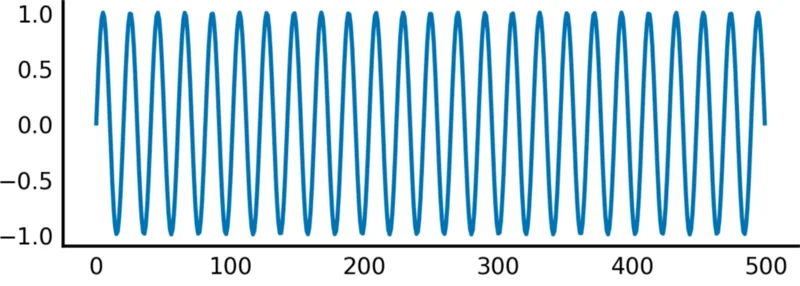
This is the raw signal. Amplitude on the vertical axis, time on the horizontal one. Somewhere inside those oscillations there are obstacles, but you cannot point at any of them. Now watch what the FFT does to it.
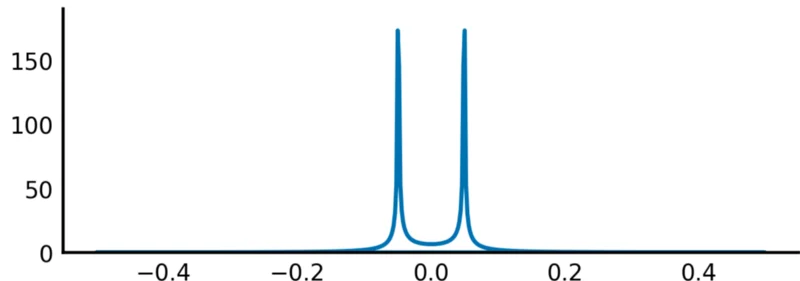
Look at what comes out. Instead of a messy wave, you get a set of clean peaks. And each peak is an obstacle, carrying its own range, its own Doppler shift, and its own power.
This is the moment physics becomes perception. Before the FFT, you have a signal. After it, you have detections.
From measurements to a point cloud
Here is where everything connects. Every peak that comes out of the FFT arrives with our 4 measurements attached: a range, a Doppler velocity, a power, and an angle.
And range plus angle is a position. If something reflects at 30 meters, 20 degrees left, you can place it as a dot in space. Do that for every peak, and you stop having a signal. You have a point cloud, exactly like the one a LiDAR gives you, except each point also carries a speed and a reflectivity.
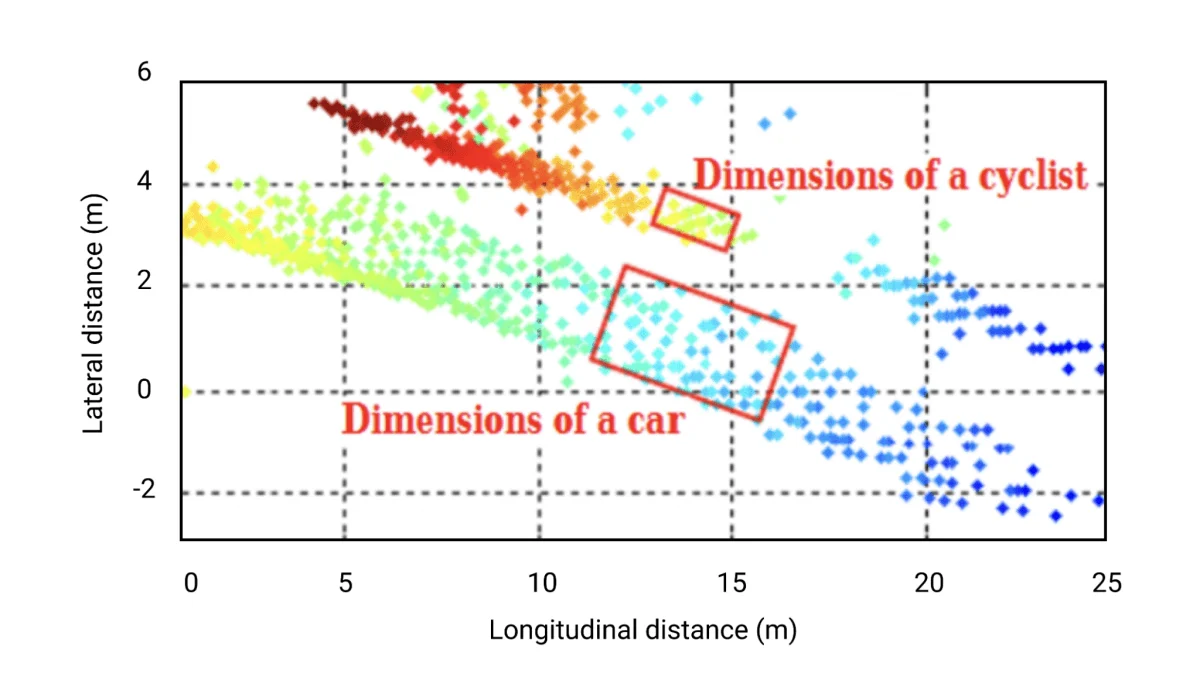
But notice the problem in this image. A single car doesn't produce one point, it produces a whole cluster of them scattered across its surface. The RADAR doesn't know which points belong together, it just sees dots.
So we group them with clustering algorithms. Euclidean Clustering or K-Means measure distances between points and merge the ones that clearly belong to the same object. One group becomes a car, another becomes a cyclist.
And that's the full chain. A wave goes out, comes back, gets transformed by the FFT, becomes points in space, and those points get grouped into a car with a position and a speed.
But isn't RADAR data too noisy to be useful?
This is the objection I hear the most, and it's a fair one. RADAR is genuinely noisy. You see one obvious obstacle and it reports 5 detections. You see an empty road and it reports something anyway. A can of soda on the asphalt can bounce a wave back and look like an object.
The first defence is the Signal to Noise Ratio. The stronger a detection is compared to the background, the more likely it's real.
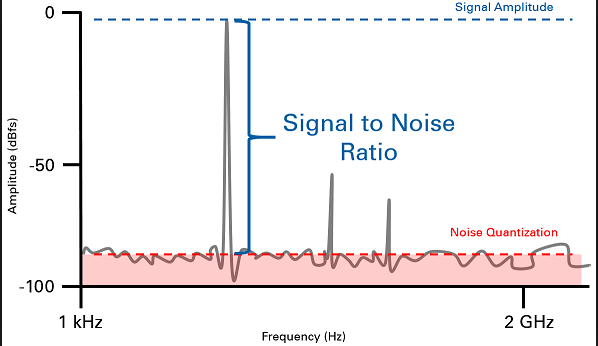
Then comes thresholding. You set a cutoff level, keep every detection that rises above it, and throw away everything underneath. Simple in principle, but the exact value you pick decides what your RADAR can and cannot see.
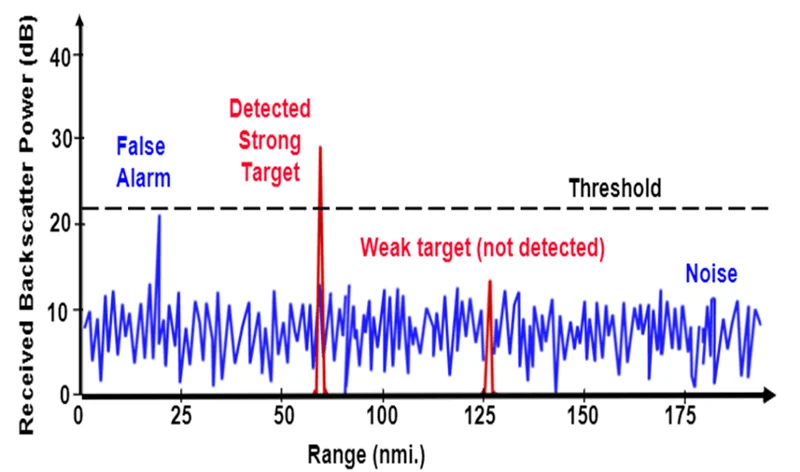
And this graph shows the whole dilemma. Set the threshold too low and noise sneaks through as a false alarm. Set it too high and you miss a weak but real target. There is no perfect value, which is why professionals use an adaptive version of this called CFAR, for Constant False Alarm Rate.
So historically, the criticism was justified. For decades RADAR was treated as a secondary sensor, too noisy and too low-resolution, useful only as auxiliary input under the assumption that noisy measurements beat no measurements.
But even then, it earned its seat. No other sensor gives you the velocity of a moving object directly. That alone was worth the noise.
And today, that assumption is breaking. High-resolution imaging RADARs now produce point clouds far closer to LiDAR than to the noisy blobs we used to deal with, while keeping the cost, the weather resilience, and the direct velocity. I covered this shift in my article on the Imaging RADAR, and you can see Deep Learning applied to RADAR point clouds in my interview with Perciv AI.
How a RADAR Perception Engineer puts it together
Everything above is the theory, so let me show you it in production. A few months ago I hosted a live session with Isaac Berrios, a RADAR Perception Engineer at Anduril, in the defense space, and he walked us through the exact stack he uses every day.
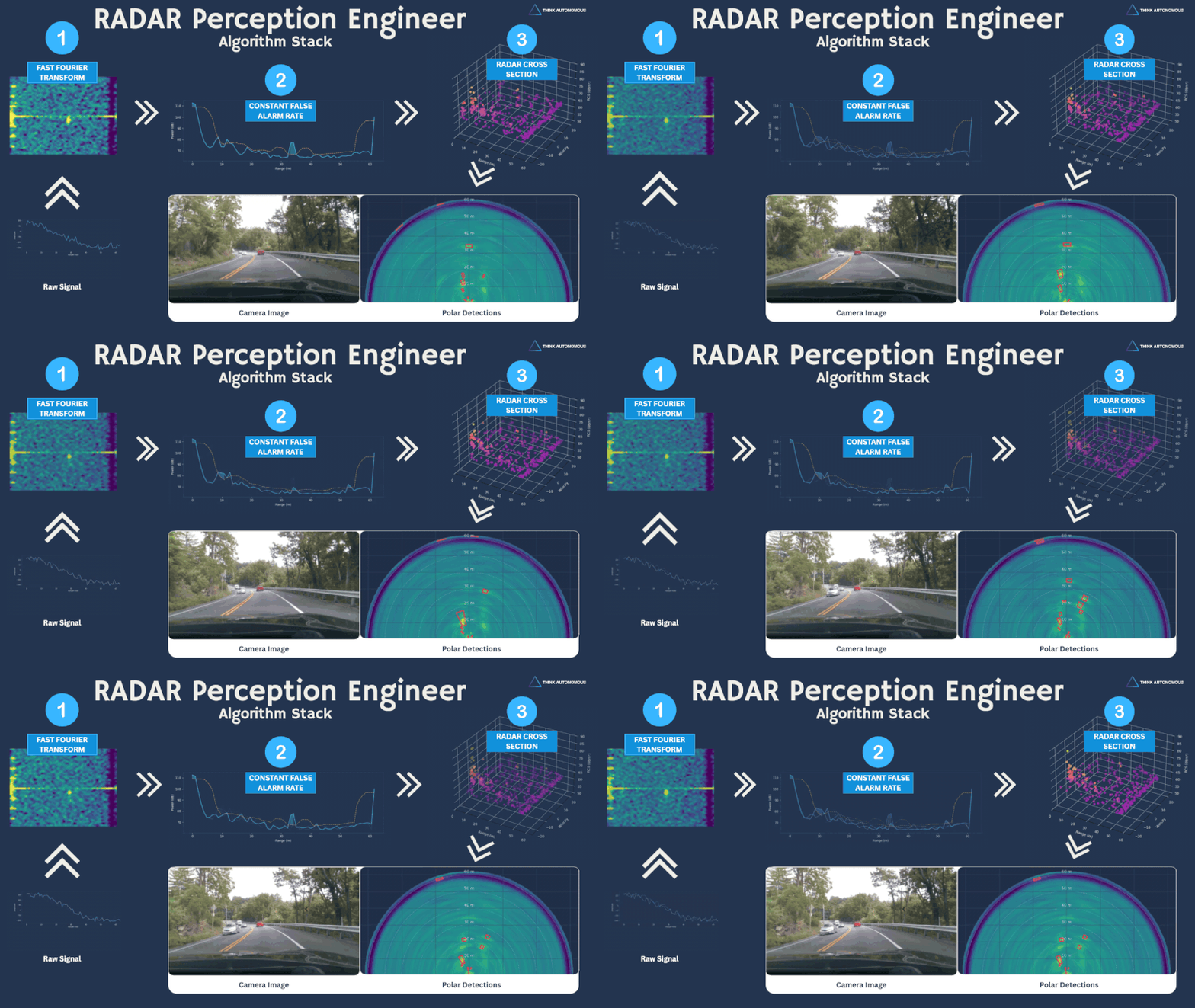
You already know all three boxes. The FFT turns the raw signal into a Range-Doppler map. CFAR pulls the real targets out of the noise. And the RADAR Cross Section tells him what those targets actually are, which matters enormously in defense, where some drones are painted specifically to push their RCS toward zero and disappear.
What struck me most was how manual it still is. Those CFAR thresholds are tuned by hand, and set them slightly too high and you simply stop seeing real objects. Same three ideas you just learned, except the consequences are a little heavier.
Summary & Next Steps
- A RADAR never sees anything, it sends a wave out and reads what comes back.
- That returning wave carries 4 measurements: time gives you range, frequency shift gives you velocity, signal strength gives you the RADAR Cross Section, and the angle of arrival gives you direction.
- The FMCW chirp is what makes this possible, by letting the sensor measure distance and speed from the same continuous signal.
- The Fast Fourier Transform turns the raw wave into detections, each peak carrying its own range, speed, and power.
- Range plus angle turns those detections into a point cloud, and clustering turns that point cloud into actual cars and pedestrians.
- RADAR is noisy by nature, so engineers filter it with the Signal to Noise Ratio and adaptive thresholding (CFAR).
- It works where other sensors fail, in rain, fog, snow, darkness, and even underneath or around obstacles.
- Imaging RADAR is changing the game, producing point clouds close to LiDAR quality while keeping RADAR's cost and weather advantages.
If you want to keep going, the natural next step is sensor fusion. I'd read Introduction to RADAR Camera Fusion next, then Sensor Fusion: LiDARs & RADARs in Self-Driving Cars for the full picture.